Choose to Enjoy Life

Another Year of Choices

By Barbara Dahlgren

 

Enjoy Life...

Christians can be some of the biggest fuddy-duddies around.  That may seem like an old-fashioned word, but what would you call a boring, humorless, crabby person with no imagination?  The Urban Dictionary says it’s a fuddy-duddy.  Is this the kind of image we as Christians portray to others?

Some Christians don’t seem to be able to smile, laugh, or have a good time.  They lack a certain enthusiasm for life.  The word enthusiasm is derived from the Greek roots en, meaning in or within, and theos which means God.  The original meaning was having God within us.  Just thinking about God living in us should make us a little enthusiastic. Yet many Christians are afraid to enjoy life.

It reminds me of the man who had his annual physical check-up and the doctor told him, “There’s no reason why you can’t live a completely normal life, as long as you don’t enjoy it.”  We think God says, “There’s no reason you can’t live a totally committed Christian life, as long as you don’t enjoy it.”

C.S. Lewis said that most Christians lack “merriment.”

William Barclay said, “A gloomy Christian is a contradiction in terms.”

Billy Sunday once said, “The trouble with Christians is that they have just enough religion to make them miserable.”

Where does this Christian “downer” attitude come from?  Certainly not from God.  We miss a lot by keeping God locked in a box of our preconceived ideas of righteousness.  Ask yourself the following questions:

A merry heart is good medicine...

Does God like it when we laugh?  I think so… Look at creation: duck-billed platypuses and long-necked giraffes. Way before cartoons, God made Balaam’s donkey speak. Why would God tell us a merry heart is good medicine if he didn’t want us to be merry?  (Proverbs 17:22)

Does Jesus like it when we party?  I think so… Jesus’ first miracle was turning water into wine at a wedding party.  (John 2:1-11) We can debate all day long about whether it was wine or grape juice – I have my personal opinion – but the point is it happened at a party and the intent was to keep that party moving. Of course God is not pleased with drunkenness, lewdness, or vulgarity, but shouldn’t we as Christians be able to show the world that people can have a good time without those things?

Does God enjoy our company?  I think so… Psalm 149:4 says God delights in his people. Delight doesn’t mean tolerate; it means He enjoys us.

Does God like dancing? I think so…The Bible is full of scriptures of God turning mourning into dancing and people praising God with dance. David danced before the Lord with all his might. (2 Samuel 6:14)

Does God like it when we shout for joy? I think so… There are plenty of scriptures that tell us to do that.  Just like there are plenty of scriptures that tell us God likes it when we praise, worship, and thank him.

Does God like it when we celebrate? I think so… Every time something good happened in the Bible there seemed to be some sort of celebration.  In a way, each new day is a time for celebration.  Psalm 118:24 says, “This is the day that the Lord has made. I will rejoice and be glad in it.” Well, guess what? Every day is the day the Lord has made. If we wake up breathing, we might want to rejoice!

Does God want us to enjoy life? I think so… 1 Timothy 6:17 tells us God provides for our enjoyment.

Consider this… There will always be people criticizing us for being Christians and actually enjoying life.  After all, they criticized Jesus.  Matthew 11:19 said that Jesus came eating and drinking. So much so that some said He was a glutton and a drunkard. They were wrong, of course.  Did Jesus stop enjoying life because of this criticism?  I don’t think so!

If we aren’t enjoying the Christian life, perhaps we don’t know God well enough.  Psalm 16:11 says that in God’s presence there is fullness of joy.  I can’t help but think that those who live and move and have their being in Christ, will be enjoying life.  (Acts 17:28)

Make someone smile


Suggestions for practicing this choice…

  • Lighten up!
  • Smile!
  • Laugh!
  • Don’t isolate yourself!
  • Thank God for your blessings and don’t feel guilty about enjoying them!
 

Posted in Uncategorized | Leave a comment

Choose to Sing

Another Year of Choices

By Barbara Dahlgren


Choose to Sing

Some of us love to sing.  When we’re alone in our Honda Civics we crank that music up loud, sing to the top of our lungs, bob our heads to the rhythm and “shake it off, shake it off” like we’re at a Taylor Swift concert.  Then we make eye contact with the person in the BMW next to us and get all embarrassed.  Well… I’d rather sing and get caught than not to sing at all.

Okay, so you can’t carry a tune and singing’s not your thing, but you can still make a joyful noise. (Psalm 100:1) Psalm 98:4 says, “Make a joyful noise to the Lord, all the earth…”  It even says, “…make a loud noise and rejoice and sing praise.”

Music and/or singing is mentioned over 800 times in the Bible.  The Psalms teach us that music was used to offer thanks, to praise and to worship God, but it was used for other purposes as well.  It was used to…

  • Soothe the soul (1 Samuel 16:23)
  • Stir up the gift of prophesy (2 Kings 3:15)
  • Inspire (2 Chronicles 20:21-22)
  • Celebrate (Ezra 3:11)
  • Express love (Song of Solomon 1-8)
  • Teach God”s Word (Colossians 3:16)
  • Release power of God (Acts 16:25-26)
  • Etch the mighty power of God in our memories (Exodus 15:1)
  • And much more

Yes, music is powerful!  Today, studies show that music can…

  • Affect your mood
  • Alter buying habits
  • Make you work more efficiently
  • Relieve pain
  • Reduce stress
  • Increase stress
  • Affect your eating habits
  • Enhance athletic performance
  • Teach children
  • Help stroke patients regain speech
  • Decrease stuttering
  • And much more

God created music and it is good. While it’s true that man has polluted the good things God created, it doesn’t mean we can’t still enjoy music the way God intended.  Every song we listen to doesn’t need to have religious overtones, but we would be better off staying away from music that incites conflict or promotes negative feelings.  We know those attitudes do not come from God.  Music can reflect moods, but it can influence moods as well.  So we should think about what we listen to.

God Sings

Consider this… God sings!  Zephaniah 3:7 tells us God rejoices over us with singing.  I don’t know if God breaks out in song when He thinks about us, just like in a musical, but I love how the Living Bible paraphrases this verse. It says, “Is that a joyous choir I hear?  No, it is the Lord himself exulting over you in happy song.”

What about us?  When we think about God do we sing a happy song.  Perhaps we should.  And when we do, there’s nothing wrong with pumping up the volume once in a while – especially if we can’t carry a tune.

Suggestions for practicing this choice…

  • Don’t judge others based on their music preferences.
  • Don’t presume God likes what you like and dislikes what you dislike when it comes to music.  In other words, don’t set up your standards as God’s standards.  There is nothing wrong with having likes and dislikes, but remember that even God enjoys a “loud” song once in a while. (Psalm 98:4)
  • Don’t assume God likes the old hymns more than the new contemporary worship songs.  There is nothing wrong with singing old hymns, but there is nothing wrong with singing a new song or even an old song in a new way.  (Psalm 98:1)
  • Try to appreciate all types of music.  Remember that appreciating something is not the same as liking it.  If we can’t truly appreciate all types of music, at least we can be tolerant.  The message being conveyed is more important that the style.
  • Think outside the box.  That’s what I love about the Go Fish Guys.  Sure their music is intended for kids but when I’m feeling a little low I pop one of their CDs in and listen to something like their Ten Commandment BoogiePretty soon I turn up the volume, sing along and bop until I drop – and guess what?  I imagine that God is singing and dancing with me.

Make a Joyful Noise


Posted in Uncategorized | Leave a comment

Choose Relationship Over Religion

Another Year of Choices

By Barbara Dahlgren

Those who sing, “Give me that old time religion; it’s good enough for me…” may not know what they are asking for.

Exactly what is religion?  Dictionaries define it as belief in a god, group of gods or the supernatural.  It can include service, worship, practices, traditions, rules, and observances.  Unfortunately, it doesn’t include a relationship with the living God.

Some pacify their need for religion by going to church once a week, wearing a cross around the neck, putting a fish emblem on a car, carrying a “Prayer of Jabez” key chain, or saying, “God bless you!” when someone sneezes.  These are not bad things to do, but if that’s all Christians rely on, they are missing the mark.  That’s what happened to the Pharisees – they missed the mark.

Jesus had a great deal of patience towards sinners.  He healed them, ate with them, extended them kindness and compassion.  However, He was not fond of the Pharisees – the religious leaders of the time who religiously kept religious laws, traditions, and observances.  They even added a few of their own to make themselves even more religious in the eyes of others.  Their over zealousness did not endear them to Christ.  In fact, it repulsed Him.  He called them vipers, evil, hypocrites, sons of the devil, blind and a few other things we don’t have time or space to explore. (Matthew 23)

You see, God is not looking for religion; He’s looking for relationship.

God created us as relational beings.  Humans long to connect with others.  We want people to understand us, empathize with us, share our joy, feel our pain, and so on.  For this to happen we must open ourselves up to others.  We talk; they talk.  We listen; they listen.  It takes a little time, but well worth the effort.

Well, God is relational as well.  He longs for a relationship with us, but He will not force it on us.  He will beckon or encourage us to come to Him.  He will make himself available.  He will love us.  He will stand at the door and knock, but He won’t come in and fellowship with us unless He is invited. (Revelation 3:20) He initiates, but we must respond on our own.

Some talk about “building a relationship” with God and while I think there is some merit to that phrase, it does make me think of hard labor.  Therefore, I’ve been leaning more towards words like interaction and participation in regards to a relationship with God.

Hebrews 13.8 - Water LiliesConsider this… Jesus is the same – yesterday, today and forever. (Hebrews 13:8) He is always near, ready and willing to connect with us.  We don’t have to build a high tower to be closer to Him.  We just need to reach out and He’s there.

How do we reach out?  We reach out through communication, which is a give and take process.  We talk and He listens.  He talks and we listen.

There is a fancy name for talking with God.  It’s called prayer.  The purpose of prayer is to spend time with God, communicating with Him. We tell him how we feel from the heart.  Since we don’t always feel the same way, our talks will vary.  Sometimes we might be angry or frightened. Sometimes we might be elated and joyful.  Sometimes we are anxious and worried.  Sometimes we are overwhelmed by God’s goodness and full of praise.  And we should always be able to find something to be thankful for.  We talk to God just like we would talk to our most intimate friend – from the heart and often.

So how does God talk to us?  God spoke to Moses through a burning bush, but I wouldn’t wait for that to happen today.  If we ask God to interact with us, He will probably do it through what we come in contact with in our daily routine – maybe through a Bible scripture, a sunset, a child’s smile, a co-worker’s off handed comment, a friend’s concern, a quote we read in a book, or various circumstances.  It may come in the form of comfort, wisdom, or even correction.  Since we are not all alike, God communicates with each of us differently.  However, we must be receptive if we want to hear what God is saying. So our thoughts need to be on Him throughout the day.

Old Time Religion

My advice is to forget that old time religion.  It’s not good enough for me and it’s not good enough for you because God did not create us for religion.  God created us for relationship.

Suggestions for practicing this choice…

  • Say this to yourself throughout the day: “God is not mad at me.  God loves me.”  God may not like everything you do but He will never stop loving you.
  • Say this to yourself throughout the day: “God is not impressed with my works; God wants my heart.”  Stop trying to work your way into heaven by adhering to a self-imposed list of dos and don’ts to make you feel more “religious.”
  • Say this to yourself throughout the day: “God is interested in everything I do.” Actually, God and your mother are probably the only ones who are interested in everything you do.  And to be honest – you can’t always count on mom.  She might just be feigning interest.
  • Say this to yourself throughout the day: “As I draw near to God, He draws near to me.” (James 4:8)
  • Say this to yourself throughout the day: “Lord, I desperately want a relationship with you.  Help me be attuned to your presence all around me.”
Posted in Uncategorized | Leave a comment

Choose to Believe Jesus Lives

Another Year of Choices

By Barbara Dahlgren

Jesus LivesChrist’s crucifixion and death showed God’s unconditional love for us.  Although painful and agonizing, Christ died willingly for our sins.  Because of this we are forgiven and no longer condemned.  And while that is great news, without Christ’s resurrection, what he did for us would be null and void.  Christ was delivered to death for our sins, but raised to life for our justification. (Romans 4:23,24) In other words His death paid for our sins, but His resurrected life is the proof or the receipt for that payment.  Jesus came to earth, died for us, and rose from the dead.  Jesus lives! This truth validates Christ and it validates us.

The resurrection validates Christ because what He said would happen did happen.  Jesus knew He was going to be betrayed, condemned, mocked, beaten and die, but He also knew and told His disciples that He would be raised to life again. (Matthew 20:18-20) And it took place just the way Jesus said it would.  This is good news for us on so many levels, one being that we can trust everything Christ tells us.

The resurrection also validates our faith in Christ.  Without the resurrection our faith is in vain and futile. (1 Corinthians 15:14-17) If Christ has not risen, we have not been forgiven of our sins.  We are dependent on a wicked world.  If we don’t believe Christ lives, we have no hope.  So we must believe without a doubt that Christ is the resurrection and life He professed to be.

Christ’s resurrection not only declares that Jesus lives and He is Lord, but it celebrates the victory of life over death.  Jesus conquered what no one could – death!  Christ’s resurrection erased all doubt in anyone’s mind.  Death can no longer hold us in bondage.  “O death, where is thy sting? O grave, where is thy victory?” (1 Corinthians 15:55) Death has no victory.  Christ has the victory.

Christ’s victory over death is our victory, too. (1 Corinthians 15:57) Because Christ lives, we can live also. (Romans 6:8, 9) We who believe in him will live – even though we might die, we will live again. (John 11:25-26)

Consider this… The fact that Jesus lives is a truth and does not depend on our perceptions or how we feel.  Jesus is actually present with us whether we realize it or not – whether we want to believe it or not.  The only one who benefits from believing Christ lives is us!  John 5:24 tells us.  “He who hears My word and believes in Him who sent Me has everlasting life and shall not come into judgment, but has passed from death into life.”  This has nothing to do with living a good life or earning salvation.  It comes from believing and trusting God.

Believe that Jesus lives. He is our only hope!

Suggestions for practicing this choice. 

  • Remind yourself often that Jesus lives.  Once Martin Luther was found in a moment of peril and fear, when he needed to grasp unseen strength.  There he was, sitting in an abstracted mood, and tracing on the table with his finger the words, “Vivit! Vivit!” – “He lives!  He lives!” (From Streams in the Desert Devotional, January 17)
  • Ask God to help your unbelief when doubts arise. (Mark 9:24) Some disciples doubted the resurrection, but Jesus came to them to calm their doubts. (Matthew 28:17-18) Remember, it is never too late to believe!
  • Repeat this often:  Jesus lives and He is with me always! (Matthew 28:20)
  • Don’t be afraid to embrace the true meaning of Easter.  It reminds us of what we sometimes forget the rest of the year.  Christ is risen and lives!
  • Listen to this Youtube song by the Gaithers…Because He Lives.  It has a powerful message.


Posted in Uncategorized | Leave a comment

Choose to Live in the Present

Another Year of Choices

By Barbara Dahlgren 

Live in the PresentSo many people live in the past and constantly lament what might have been.  They spend all their time focusing on things they can do nothing about.

They obsess over things like…if only I had married the geek I thought was a loser in college who became a millionaire.  If only I had taken that job with the start-up company I thought would go nowhere but went sky high.  If only I hadn’t gotten pregnant at sixteen.  If only I had finished college instead of dropping out.  If only I hadn’t gotten drunk and had a tattoo of a naked lady put on my arm.  If only, if only, if only…

Everyone’s life is full of missed opportunities, some unwise decisions, and regret.  These things cannot be changed.  It is better to accept and learn from them and move on.  Yet many seem held captive by things they can do nothing about.

Others put their lives on hold waiting for the future.  Yes, we look toward the future but we live today.  God lives in the present.  His name is “I am” not “I was” or “I will be” or “I might have been.”  This walk with God is a day by day journey and we miss much when we don’t focus on what God has in mind for us today.

Consider this…God doesn’t supply tomorrow’s needs today.  The Israelites found that out when they tried to store up manna for another day. (Exodus 16)  There is nothing wrong in planning for the future but God supplies our needs on a daily basis.  We pray “give us today our daily bread.”  Matthew 6:30-34 tells us not to worry about tomorrow.  God’s got that covered.

Instead of lamenting the past or worrying about tomorrow, Matthew 6:33 shows us where our focus should be: “But seek first the kingdom of God…”  You see, our job is to seek God, participate in a relationship with Him, be alert and attuned to His presence all around us – on a daily basis.  We need to concentrate on what God is doing with us today.  That’s our priority – and we can’t do it when we are constantly living in the past or waiting for the future.

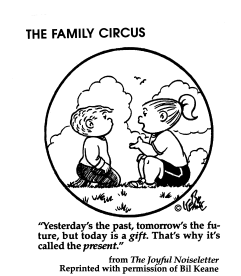
How to Live in the Present - Family Circus Cartoon

Suggestions for practicing this choice…

  • Read a few Bible verses each day and think of how they can be applied in your life today.
  • Ask God to help align your will to His and to make His desires your desires.
  • Be attuned to God’s creation all around you – a sunrise, a sunset, the rain, the flowers, the birds, the trees, the mountains, the river, the butterfly, a child’s laughter – whatever you see, hear, smell, or touch can relate to your Creator in some way.
  • Pray many times throughout the day. (1 Thessalonians 5:16-18) Pray big prayers and lots of little prayers – little prayers of praise, thanks, and requests for immediate help keep your focus on Jesus. (Hebrews 12:2)
  • Guard your thoughts by meditating all day long about God’s Word, biblical principles, and how Christ would handle situations. (Psalm 1:2, Joshua 1:8)
Posted in Uncategorized | Leave a comment

Choose to Avoid Spiritual Burnout

Another Year of Choices

By Barbara Dahlgren

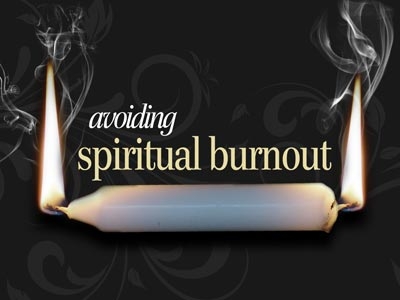
Avoid Spiritual BurnoutMost Christians want to serve but don’t know how to avoid spiritual burnout in the process.  To be honest, I’m not sure I know how to avoid it either.  At one time or another we all try to “work” our way to righteousness on the spiritual treadmill, desiring to reach some lofty vision we see as the ultimate Christian experience.  We don’t want to become modern day Pharisees, but these “work” oriented goals do tend to make us feel just a little superior to others.  Keeping a mental list of what we need to do to attain righteousness leaves us living more under law than grace.  If we fall into the personal performance trap, it won’t be long before we run out of steam.  Performing godly tasks on our own strength instead of God’s can lead to burn out.   God’s flame is eternal and never burns out.  Our feeble flame can definitely burn out.

Depression, stress and burnout can have overlapping symptoms but actually fall into three different categories.  Depression is usually linked to a loss and a person’s lethargic inability to face life. Stress produces hyper-activity, emotions become over reactive, and the person literally wears out and gets exhausted.  But with burnout, there is a lack of motivation and drive – not because of a weakened, physical condition but because the will to do anything is gone.  Ideals and hope are lost.  There is no excitement about life.  The joy in the journey is gone.  In other words, “What’s the use?”

Can good, serving Christians suffer burnout?  You better believe it!  Burnout can be the result of too much service for the wrong motivation.  So we must ask ourselves why we do what we do.

Are we trying to impress others?  Many try to please others, seeking approval and fearing criticism.  Therefore, they have trouble evaluating where their time is best spent or setting up boundaries.  They can’t say “no” to others.  When their efforts don’t reap the results they hoped, they get disheartened and discouraged.  When they can’t live up to their own expectations or the expectations of others they feel like failures.  However, these are not God’s expectations.

Are we serving in an area that brings us joy?  When we minister in areas that match our gifts and talents, we can feel as if we are meant to do this.  Some are perfectly happy there, but others get tired of doing the same old thing and may decide to try another area of service – some new endeavor they feel excited about – something they want to learn.  They hesitate, fearing others will not be supportive, so they don’t move on.  Or worse, people guilt them into thinking if they don’t do it, no one will.  However, God does not want us to serve out of guilt, but joy.

Are we working for God’s glory?   We should be working for God’s glory – not ours – not just for the good of others.  We cannot be the spiritual nourishment for others.  Needy people can drain us dry.  While it might be fine to let someone lean on us for a short time, the ultimate goal is to get them to lean on God.  We can’t do this for them.  And if we are trying to do it for them, we are not doing it for God’s glory.  We’ll be doing it on our own strength or steam.  It’s better to rely on God’s strength and teach others to do the same.

Consider this… We can spend a lot of time and effort doing things for God he does not require us to do.  Workaholic Christians rarely find time for the most important priority – relationship with the living God.  Once a relationship develops, the motive of service becomes love, not obligation.  It’s not how much we do that counts; it’s why we do what we do.  We need to keep our eyes focused on Jesus. (Hebrews 12:2) Our lives need to be God centered, not work oriented.  Remember… our flames are feeble, but God’s flame is eternal and never burns out.

Eternal Flame

Suggestions for practicing this choice…

  • Spend time with God daily.
  • Ask God to renew spiritual excitement in your life and guide you to areas of service that will bring you joy.
  • Learn to say “I’ll pray about that” when someone asks you to do something.
  • Ask the Holy Spirit to equip or empower you to do what God would have you do
  • Let God give you rest.  (Matthew 11:28-30)


Posted in Uncategorized | Leave a comment

Choose to Do What You Can

Another Year of Choices

By Barbara Dahlgren

Don't let what you can't do...Most of us will never give up all our worldly possessions to serve the poor, leave a lucrative medical practice to be a missionary in Africa, or travel the world to preach the gospel while bringing hundreds of people to Christ.  That’s because most of us were not called to be like Mother Teresa, Dr. Albert Schweitzer, or Billy Graham.  But that doesn’t make our lives any less meaningful or important in God’s eyes.  Maybe we were called to live ordinary lives – doing what we can to serve God and others regardless of circumstances.

An old adage states:  We can’t all cross the ocean, but we can still stand on the shore and help launch the ships.  In other words, those who stay behind doing God’s work are just as important as those that go to the forefront.

David understood this principle.  When he and his men fought the Amalekites, some went into battle and some had to stay behind to guard the carriages and baggage left behind so the pursuit could move faster.  When the soldiers returned victorious with the spoils, many did not want to share the bounty with those who had not gone into battle.  They felt their jobs were more important than those who remained behind.  David did not agree.  He said that all would share in what God had given them equally.  “The share of the man who stayed with the supplies is to be the same as that of him who went down to the battle. All will share alike.” (1 Samuel 30:21-25)

Consider this… We all have different strengths and weaknesses.  Some may have a desire to serve in greater capacities but might be limited by health problems, finances, family obligations, and so on.  God did not intend for everyone to live in a limelight.  But just because someone goes unnoticed doesn’t mean they aren’t significant.  We all must do what we can.  And we all share in the same reward with God.

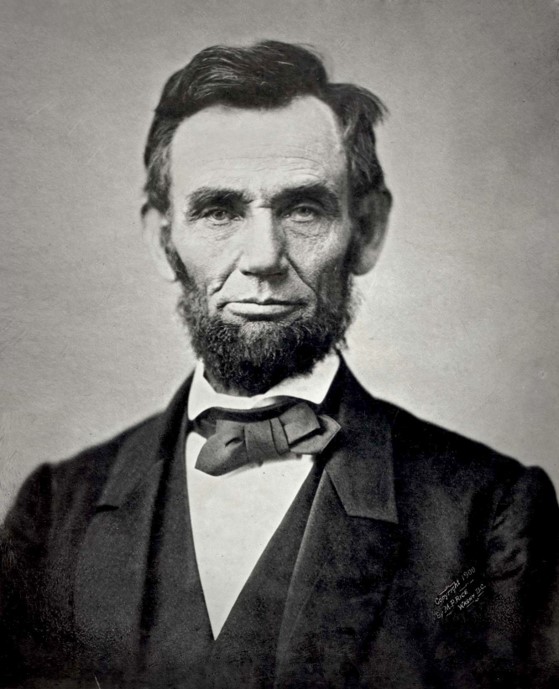
Abraham Lincoln

During the Civil War, Helen Gates wrote a poem called Your Mission which was set to music and sung for President Lincoln at a United States Commission meeting in January 1865, just a few months before the war ended.  The song brought tears to the president’s eyes, and he asked for it to be sung again at the close of the gathering.  This is one of my favorite poems, and I think there’s a message in it for all of us to do what we can do.  


Your Mission

By Ellen Gates

If you cannot on the ocean
Sail among the swiftest fleet
Rocking on the highest billows,
Laughing at the storms you meet,
You can stand among the sailors,
Anchored yet within the bay,
You can lend a hand to help them
As they launch their boats away.

If you are too weak to journey
Up the mountain, steep and high.
You can stand within the valley
While the multitudes go by;
You can chant in happy measure
As they slowly pass along—
Though they may forget the singer,
They will not forget the song.

If you have not gold and silver
Ever ready at command;
If you cannot toward the needy
Reach an ever-helping hand.
You can succor the afflicted,
O’er the erring you can weep;
You can be a true disciple,
Sitting at the Savior’s feet.

If you cannot in the harvest
Garner up the richest sheaves,
Many a grain, both ripe and golden,
Oft the careless reaper leaves;
Go and glean among the briers
Growing rank against the wall,
For it may be that their shadow
Hides the heaviest wheat of all.

If you cannot in the conflict
Prove yourself a soldier true,
If where fire and smoke are thickest
There’s no work for you to do,
When the battlefield is silent,
You can go with careful tread—
You can bear away the wounded,
You can cover up the dead.

Do not, then, stand idly waiting
For some greater work to do;
Fortune is a lazy goddess—
She will never come to you.
Go and toil in any vineyard;
Do not fear to do or dare—
If you want a field of labor
You can find it anywhere.

Suggestions for practicing this choice…

  • We’ve used this suggestion from Seventh Century monk, St. Isaac the Syrian, before, but it is worth repeating.  “If you cannot labor with your body, at least make efforts with your mind… If you can’t fast for two days, fast at least till evening… If you are not a peacemaker, at least do not be addicted to strife… If you cannot close the mouth of a man who is judging his brother, at least refrain from joining him…” Do what you can do!
  • Jesus said that sometimes just giving a cup of water to someone is important. (Matthew 10:42)
  • Here are a few things you can always do:  praise God and be thankful.
  • Here are a few more things you can always do:  smile at all you meet, send notes of encouragement to others, be a good friend, rejoice with those who are happy, and mourn with those who are grieving.
  • Here’s something else you can always do: be a prayer warrior.  We should pray always and never give up.  (Luke 18:1)
Posted in Uncategorized | Leave a comment

Choose to Partner with Others

Another Year of Choices

By Barbara Dahlgren 

PartnershipIn our last blog we discussed the importance of doing our part by participating in what God is doing.  Sometimes our part can mean partnering with others doing God’s work.  “Partner” is defined as one who takes part in an undertaking with others.  We don’t always need some new idea.  We don’t always have to be the one in charge.  There are plenty of opportunities to get involved with others who are headed in the right direction.

The example of Nehemiah rebuilding the wall of Jerusalem comes to mind.  While living in Persia, Nehemiah heard about the plight of his fellow Jews who had been allowed to return to Jerusalem after years of captivity.  Nehemiah felt God calling him back to his homeland to rebuild the walls of Jerusalem.  When he got there the city was in ruins.  It would be a daunting task to get everyone on board to rebuild.  So first he enlisted the help of the leadership – then others.

Now usually when we see a list of names in the Bible we skip over them.  But if we read Nehemiah 3 carefully, we see rulers, priests, nobles, and officials working alongside all the merchants, farmers, and laymen.  Notice the many times the phrase “next to him” is used.  Everyone, regardless of rank or status, was working together, doing the hard labor to get the job done.  People came from other cities and even the women were working with them.  (Nehemiah 3:12) There may have been craftsmen for certain jobs but many learned how to do things as they went along.  Others probably picked up the stones, kept tools sharpened, brought the lunch, or passed out drinks of water, but they all did their small part, working together, to rebuild the wall. (Nehemiah 4:6)

Sure there were some who chose to stand on the sidelines, cause problems, and “nay-say” about what was going on.  Such was the case when Ezra was rebuilding the temple as well.

Here again we have many working together to get this job done.  Specialized skills were needed by masons and carpenters.  Those who did not have such skills contributed by providing “meat, and drink, and oil.”  (Ezra 3:7) Others gave “freewill offerings” to support the project. (Ezra 2:68) In other words, it was the work of all the people – partnering together and contributing in one way or another.

However, rebuilding the temple was a slow process with many setbacks.  Opponents tried to squelch the efforts.  Some old-timers lamented that the size and grandeur of this temple would never equal the first. (Haggai 2:3) Workers were getting discouraged and thought, “What’s the use?”  What they were doing seemed pitiful and small. But God had a different perspective.  He encouraged them to take heart and assured them the temple would be completed.  Then He asked a rhetorical question containing a life lesson for all of us.  “For who has despised the day of small things?” (Zechariah 4:10) In the eyes of the people this work may have seemed pitiful and small, yet it was God’s work all the same.

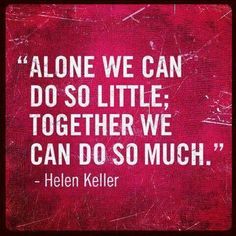
Helen Keller - Alone we can do so little....

Consider this… Sometimes what we are doing may seem insignificant and small – but not in God’s eyes.  The important thing is to be a part of what He has going on.  Why not participate or partner with those who are doing God’s work?  Those sitting on the sidelines are tempted to criticize and lose out on God’s blessings!

Suggestions for practicing this choice…

  • Find a worthy cause close to your heart and get involved.  We were created to do good works, but not alone. (Ephesians 2:10) The Bible says, “Two are better than one” because they can get more done. (Ecclesiastes 4:9-10) If one falls, the other can pick him up.
  • Don’t be a loner.  We can accomplish more working together – especially when God is involved.  “One can chase a thousand while two can chase ten thousand.” (Deuteronomy 32:29-30)
  • Be a team player.  Don’t always think your way is the only way to accomplish something.  Team means:  Together (T) Everyone (E) Achieves (A) More (M)
  • Learn to “play well with others.”  A sportscaster once said, “You don’t win with the best talent; you win with five players who are able to play well together.”
  • We were not created to be alone.  We were created for relationships so “partner” with the Father, Son, and Holy Spirit!  You’ll be glad you did.


Posted in Uncategorized | Leave a comment

Choose to Participate

Another Year of Choices

By Barbara Dahlgren
ParticipateWhen we accept Jesus as our Savior, we know that salvation is a given.  It’s a done deal.  However, we are expected to do more than just bask in the glory of knowing we are saved.  Our relationship with God is not all up to Him.  We must have a desire to know Him, walk with Him, and seek His presence.  We need to participate in what the Father, Son, and Holy Spirit have going on, not just observe.  We should be participants, not spectators.  So we need to do our part.     

Relationship with God involves participation in what He is doing.  Yes, God can do it all, but where does that leave us? God does not generally do for us what we can do for ourselves.  There is a difference in asking God to bless our work than asking Him to do it for us.  All through the Bible God required some sort of participation.  When Jesus performed miracles He could have just waved his arms, said abracadabra, and had everything done automatically.  He usually didn’t do that because He wanted people to be a part of what he was doing.  Here are a few examples.

  • When He turned water into wine, He had men bring barrels of water. (John 2:7-8)
  • When He raised Lazarus from the dead, He asked the people to roll away the stone. (John 11:39-44)
  • When He was going to feed the 5000, He had a little boy share his lunch. (John 6:9-13)
  • When the disciples weren’t catching fish, He had them cast the net on the other side. (John 21:6)
  • When He was going to heal the man with a withered hand, He told the man to stretch out his hand. (Matthew 12:13)

Even though God parted the Red Sea, the Israelites still had to walk through it.  If they had not walked through it, they would not have gotten to the other side.

Sometimes our part is just to “arise” – get up and get going.  On the surface it may seem simple, but sometimes it can be hard to just get out of bed and face another day.  Elijah was discouraged because Jezebel was after him, so he laid down under a juniper tree and asked God to let him die.  But God sent an angel who said, “Arise and eat.”  So Elijah ate…but he laid back down.  The angel came again and said, “Arise and eat so you can go on a journey.”  In other words, “Okay, Elijah, now the pity party is over.  Time to get up and get going.”  And that’s what Elijah did.  His discouragement didn’t leave immediately, but this was a step in the right direction.  (1 Kings 19:1-9)

Patsy Clairmont

Popular author and Women of Faith speaker, Patsy Clairmont, knows how difficult it can be to just get out of bed.  At one conference she spoke about her struggle with agoraphobia, the fear of open spaces and crowds of people.  For years she couldn’t even walk to her mailbox.  She felt trapped in her house.  She didn’t even want to get out of bed.  One day her prayer changed from, “Lord, fix me” to “Lord, I’ll do whatever I need to do to get well.”   She thought she could hear the Lord whispering for her to get up and make her bed.  Some days that’s all she could do – but she arose and made her bed.  It was the start of her slow, long and difficult road to recovery.  She had to do her part to participate in her recovery.

Consider this… “Part” is “part” of the word “part”-icipation.  God is certainly willing to do His part; are we willing to do our part, no matter how small it may seem?

Suggestions for practicing this choice…

  • Participation means to do something. Of course we want God involved in everything we do so prayer is a key component is what we choose to do.  However, lazy prayers will not produce good fruit.  We can’t just lie in bed and say, “Lord, if you want me to eat today just drop the food in my mouth.”  We can’t say, “Lord, I know if you want me to work, you will bring me a job.”  Do something!
  • Volunteer for a worthy cause.  You don’t need to sign your life away but you can probably spare a few hours a month or a week for others.  Do something!
  • Try to improve by learning a new skill, taking a class, joining a bowling team!  Do something!
  • Don’t be afraid of failure!  Thomas Edison tried to invent the light bulb 1000 times before he got it right.  Do something!
  • If we are addicted to activity, here are some things we may need to do:  slow down, spend more time meditating and take a nap!  Instead of forging ahead from one activity to another it might be good to include God in our planning and wait for Him to direct us.  That way we can participate in what He wants, not what we want.
Posted in Uncategorized | Leave a comment

Choose to Be the Best You Can Be (Do Your Best)

Another Year of Choices

By Barbara Dahlgren

Be the Best You Can BeSome people strive to be the best or at least “better than everyone else.”  This philosophy coerces us into comparing ourselves with others, which is not wise.  (2 Corinthians 10:12)  Those better than everyone can be self-righteous.  Those who aren’t can be frustrated, envious, jealous, discontent or have a “what’s the use” attitude.

A story is told of a king who went into his garden one morning and found everything withered and dying. He asked the oak standing near the gate what the trouble was. The oak said it was sick of life and determined to die because it was not tall and beautiful like the pine. The pine was all troubled because it could not bear grapes, like the grapevine. The grapevine was going to throw its life away because it could not stand erect and produce fruit as big as the peach tree. The geranium was fretting because it was not tall and fragrant like the lilac.  And so it was throughout the garden.  Yet coming to a violet he found its bright face lifted as cheery as ever. “Well, little violet, I’m glad, amidst all this discouragement, to find one brave little flower. You do not seem to be the least disheartened.”

Violet

“No, I am not of much account, but I thought that if you wanted an oak, or a pine, or a peach tree, or a lilac, you would have planted one.  Since I knew you wanted a violet I am determined to be the best little violet I can be.” (Modified from Streams in the Desert, by L.B. Cowan)

I’m sure we can see the parallel.  God is our king.  He created and planted us.  Are we determined to be the best we can be for Him?  Or do we lament and pout because we can’t do what others can do?

Parable of the Talents

We are not all created equal.  We have different strengths, weaknesses, and abilities.  (Romans 12:6)   But it’s what we do with what we’ve been given that counts.  This is evident in the parable of the talents when a rich man entrusts his money to his servants.  He gives one servant five talents, one servant two, and another only one.  Each was expected to increase.  The first two servants increased 100 percent.  They were rewarded for their efforts.  In fact, they were given the same reward.   The servant who received the most talents to work with wasn’t rewarded more than the other.  It was the percentage that counted – what each had done with what they had been given.  The one who was only given one talent produced nothing.  He was chastised and his money, what little he had, was taken away.  (Matthew 25:14-30)

Jesus tells us the widow who gave her meager offering was better than all the rich who gave theirs.  (Mark 12:41-44)  It’s what we do with what God has given us that counts.  It’s all a part of being the best we can be; doing the best we can do with what we have.

That’s why the jobs we have are not as important as how we do them.  All of us should do our jobs the best we can, as if we are doing them for God. (Colossians 3:23)  It doesn’t matter if we are CEOs, bag boys, plumbers, maids, doctors, ditch diggers, administrative assistants, accountants, waiters, students, cooks, bus drivers, dishwashers, day care workers, clerks, and so on – we should all do the best we can do.  David wasn’t always a king.  At one time he was a shepherd boy who took his job seriously enough to protect the sheep. (1 Samuel 17:34-37)

Helen Keller was both blind and deaf from infancy, but eventually went on to graduate from college to become a world famous writer and activist.  She said, “I am only one—but I am one. I cannot do everything, but I can do something. What I can do, I ought to do. What I ought to do, by the grace of God, I will do.”

Consider this… All of us are but one.  We can’t do everything but we can do something.  What we can do, we should do.  That’s what being the best we can be is all about.  And with God’s grace and help we can do even more.  As the saying goes, “Do your best and God will do the rest!”

Do Your Best and God Will Do the Rest

Suggestions for practicing this choice…

  • Do the best you can do.
  • Apply Seventh Century monk, St. Isaac the Syrian’s, advice to your life:  “If you cannot labor with your body, at least make efforts with your mind… If you can’t fast for two days, fast at least till evening… If you are not a peacemaker, at least do not be addicted to strife… If you cannot close the mouth of a man who is judging his brother, at least refrain from joining him…”  Do what you can.
  • Don’t let fear of failure keep you from doing something.  The servant with only one talent thought if he did nothing he would not make a mistake.  However, he found out doing nothing was the biggest mistake of all.
  • Don’t compare yourselves to others.
  • Read this little poem often to keep you on the right track…

Others may do a greater work,
But you have your part to do;
And no one in all God’s family
Can do it as well as you.


Posted in Uncategorized | Leave a comment