Choose Not to Focus on Failure

One More Year of Choices

By Barbara Dahlgren 

Guess what? Everyone fails from time to time. Failure is not fatal. Failure is not final. Failure is not the end of the world. We can’t afford for mistakes or set-backs to make us feel like failures. Failure, if not kept in proper perspective, can make us feel like giving up.

Here’s a little “Guess Who” game.” Can you guess the name of the person one might think is a failure?


Q: Who performed badly in almost all of his high school courses and flunked his college entrance exams?

A: Albert Einstein (theoretical physicist)


Q: Who struck out 1330 times during his baseball career?

A: Babe Ruth (professional baseball player)


Q: Who failed the sixth grade and lost every public office he ran for, except one?

A: Winston Churchill (Prime Minister of U.K.)


Q: Whose first three automobile companies failed?

A: Henry Ford (industrialist, founder of Ford Motor Company)


Q: Who was barely able to read or write at age ten, was yanked out of school, and taught by a tutor who quit in disgust?

A: Pablo Picasso (painter, sculptor, printmaker, ceramicist, poet, playwright)


Q: Who was fired from her television reporting job because she wasn’t “fit to be on screen?”

A: Oprah Winfrey (queen of television talk shows)


Q: Who was fired from the Kansas City Star in 1919 because he “lacked imagination and had no good ideas?”

A: Walt Disney (entrepreneur, animator)


Q: Whose teacher called him a “hopeless dunce?”

A: Beethoven (composer)


Q: Who made a screen test and the evaluator wrote that he “can’t sing, can’t act, slightly bald, can dance a little?”

A: Fred Astaire (famous dancer, singer, actor, choreographer)


Q: Who tried 200 unsuccessful vaccines for polio before finding the one that worked?

A: Jonas Salk (medical researcher, virologist)


Q: After a performance at the Grand Ole Opry, who was told he was better off driving a truck than singing?

A: Elvis Presley (singer, actor)


Q: Who started a lot of businesses which all failed and lost several elections for public office?

A: Abraham Lincoln (president of the United States)


Q: Who was rejected by the California School of Theater, Film, and Television three times?

A: Steven Spielberg (director)


Q: Who was cut from his high school basketball team?

A: Michael Jordan (professional basketball player)


Q: Who graduated 42 in a class of 43?

A: Napoleon Bonaparte (military and political leader)


Q: Who had 10,000 failed experiments before figuring out how to work the light bulb?

A: Thomas Edison (inventor)


Thomas Edison said he didn’t consider those experiments failures; he considered them education. “I know 10,000 things that don’t work.” There are some things that can only be learned by failure.

Yes, failure hurts, but everyone fails at something. Smart people learn from their failures and move on. That’s what makes the difference. We can’t afford to let other people’s opinions of us determine what we will become. After all, it’s God’s opinion of us that really matters and He thinks we’re pretty special. So we can’t let failures become excuses to give up and stop trying. Failures are setbacks. Setbacks are learning experiences.

Failure can actually make us work harder and become more determined to succeed. It can help us refocus our energies or change direction. A little failure in our lives helps us to be sympathetic towards others and not so judgmental. Failure helps us rely on God.

Consider this… God doesn’t just want us to be observers in the game of life. He wants us to get in there and give it our all, do it with all our might. (Ecclesiastes 9:10) God is all about participation and doing our best. When we stumble, God wants us to get up and finish the race.

Success isn’t always winning; failure isn’t always losing. There is no failure unless we decide not to try. It’s as simple as that!


Suggestions for practicing this choice…

Everyone fails, but how we handle failure determines if we will be bitter or better. Determine to learn from your mistakes, not repeat them.

Don’t blame others for your mistakes. Accept responsibility. Make changes. Move on.

It’s better to do something imperfectly than to do nothing at all. Don’t let failure keep you from doing stuff.

When a certain process isn’t working for you then reframe, revise, and refocus. Make evaluations to determine how to proceed. That’s what Edison had to do every time his light bulb experiment didn’t work.

Always remember God is here for you. When we fall down, He can help us get back up. If we don’t have the strength to get up, He will lift us up if we ask Him for help.

Posted in Uncategorized | Leave a comment

Choose Not to Be a Pessimist

One More Year of Choices

By Barbara Dahlgren

Last time, we explored the dangers of negative thinking. Those who entertain negative thoughts long enough become pessimists. Pessimists see the worst aspect of everything. They look on the dark side of life. Think of Winnie-the-Pooh’s friend Eeyore. He’s an old, gray stuffed donkey who is always gloomy and depressed. A conversation with Eeyore could go something like this:

“Hi Eeyore! What a beautiful, glorious day! The sun is shining. The birds are singing! It’s great to be alive.”

Eeyore might respond with, “Well…I don’t know. The sun is shining now, but it will probably rain. I think the birds are out of tune. I’m alive now, but I’ll probably die later today.”

We’ve all known people like that. What a joy to be around! They light up a room by leaving it.

The opposite of being a pessimist is being an optimist. Optimists are hopeful and want to find the pony in the manure. They look on the bright side of life. Think of a young Pollyanna who used to play the “Glad Game.” No matter how bad things were, she always found something to be glad about. A conversation with her could go something like this:

“Hey Pollyanna! I just broke my leg. What do I have to be glad about?”

Cheerful Pollyanna might say, “Well…you can be glad you only broke one leg.”

To be honest, both extremes get on my nerves. But with that said, I’ll take the optimist ten to one over a pessimist.

To the pessimist, a fireplace is a source of smoke and ashes. To an optimist, it is a center of warmth and beauty. A pessimist curses the darkness. An optimist lights a candle. The pessimist sees the difficulty in every opportunity. The optimist sees the opportunity in every difficulty. When confronted with Goliath-sized problems, the pessimist says, “He’s too big to hit.” The optimist says, “He’s too big to miss.” How we think determines our outlook on life.

Remember the story of the twelve spies who were sent to survey Canaan? (Numbers 13) God told Moses to send twelve men to spy out the land He had promised the Israelites. They were to survey the land and see what it was like. Was it fertile or barren, full of forests or open fields? Were the people strong or weak, few or many? Were the cities strongholds or camps?

So they went to do their duty. They even brought back some fruit of the land – figs, pomegranates, and grapes. When they returned, everyone gathered together to hear their report. Joshua and Caleb said the land flowed with milk and honey. There were a few problems but nothing they couldn’t handle with God’s help.

The other ten spies basically said, “Are you out of your mind? You are crazy. We can’t take these people. They are stronger and bigger than us. They are like giants and we are like grasshoppers.”

Now, all twelve had seen the same land and people. The difference had to be in their perspective. The ten spies with the pessimistic report could only see obstacles. They felt inadequate and didn’t want to tackle it. Joshua and Caleb looked at the task ahead and knew nothing was too difficult for their God to handle. After all, had God not brought them out of Egypt and parted the Red Sea?

Consider this… Those who don’t look to God will tend to be more pessimistic, dissatisfied, and feel lacking. Those who truly trust and believe God will tend to be more optimistic.

We all have obstacles and problems in our paths at times. They can come from our families, our workplace, our friends, and our own hearts. The pessimist will see trouble. The optimist will see God.


Suggestions for practicing this choice…

Remember this rhyme: Two men looked out of prison bars; one saw mud and the other saw stars.

During the day, think about the good qualities of your family, friends, and co-workers, not the things that drive you crazy.

Focus on solutions, not problems.

Ask God to change your outlook so you will be a more positive person. Not just for your sake, but for all those around you, too.

At the end of the day, be glad and thankful for what you got done, not sad and despondent about what you didn’t get done.


Posted in Uncategorized | Leave a comment

Choose Not to Entertain Negative Thoughts

One More Year of Choices

By Barbara Dahlgren

We live in a “put-down” society – one that is eager to point out our short comings. We are not thin enough, smart enough, or good enough – and probably never will be in the eyes of this world. This negative input gives us a flawed perspective of how we really are. The mind entertains these negative thoughts, plays tricks on us, and sabotages our happiness.


Negative thoughts can make us hide and retreat from life. Our lives become limited because we hesitate to build friendships, develop relationships, and try new adventures. We think people don’t like us. We think we are ugly. We think we aren’t good enough. We think we are unlovable.

What we think about ourselves can impact our lives. If we tell ourselves we have no friends long enough, we may end up friendless. If we tell ourselves we can’t do something, more than likely we won’t even try. Because “as a man thinks in his heart, so is he…” (Proverbs 23:7) People who feel they are fat and stupid will gladly soothe their sorrows with a super-sized burger meal while spending all their time watching reruns of Sponge Bob Square Pants.

And let’s face it – we are all prone to be influenced more by the negative than the positive. Ten positive comments can be quickly overshadowed by one negative. In fact, we will tend to forget the ten positive comments and obsess over the one negative. So we must work all the harder to maintain a positive frame of mind.

According to the Mayo Clinic, those who practice positive thinking decrease stress, improve overall health, and increase coping skills. I guess there is a reason people still read Norman Vincent Peale’s book The Power of Positive Thinking, even though it was written in 1952. It has sold over 20 million copies in 41 languages. I’ve had my copy for over forty years and still reread parts of it every now and then. Although a bit outdated, the overall principles still ring true. Positive thinking enhances our lives.

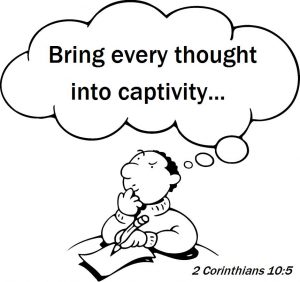
Consider this… Why does God tell us to bring every thought into captivity? (2 Corinthians 10:5) God knew our thought process could get us into big trouble. Negative thoughts breed negative outcomes. It takes a conscious effort on our part to keep thinking positive thoughts.

Paul gave sound advice in Philippians 4:4-8: rejoice always, be thankful, guard your mind, pray, don’t be afraid, and think about what is true, noble, lovely, good, virtuous, and praiseworthy.

Therefore, we need to fill our minds with thoughts of God and Christ, thoughts about good and pleasant things. We need to stop putting ourselves down. God doesn’t put us down and we shouldn’t put ourselves down either. We need to fill our minds with God’s words.

If these things are done often enough, our minds will just naturally go to the positive instead of the negative.


Suggestions for practicing this choice…

Start each day with a positive thought. Take a few breaths and focus on something you are thankful for. You’re alive, aren’t you????

Remember this: A positive outlook may not solve all your problems, but it will annoy enough people to make it worth the effort.

Force yourself to smile whether you want to or not. It does wonders for your mental outlook.

Each day concentrate on a specific, positive scripture. Put it on a 3×5 card and read it often during the day. Soon it will become of part of your thought pattern. Here are a few to get you started. I have just listed the concept; you can look up the scripture.

  • Proverbs 3:5 – Trust in the Lord and lean not to thine own understanding.
  • John 10:10 – God came so we could have an abundant life.
  • Luke 18: 27 – Things that are impossible with men are possible with God.
  • 2 Timothy 1:7 – God has not given us a spirit of fear.
  • Psalm 46:1 – God is our refuge and strength.
  • Philippians 3:13,14 -Forget the past and press forward.
  • Isaiah 26:3 – Perfect peace comes from God.
  • Philippians 4:4, 5 – Rejoice! Be thankful!
  • Philippians 4:8 – Think on positive things!

End the day with a positive thought. There must be at least one thing that happened during the day you can be thankful for. You’re still alive, aren’t you????

Posted in Uncategorized | Leave a comment

Choose Not to Forget Those Who’ve Touched Your Life

One More Year of Choices

By Barbara Dahlgren

A few years ago I read an interesting book titled Unfinished Business: One Man’s Extraordinary Year of Trying to Do the Right Things. I think about it from time to time, when the busyness of the world causes me to forget others.

The author Lee Kravitz was laid off from his job as editor of Parade magazine, so he decided to reassess his life. Although just fifty-four, this self-professed workaholic discovered he had become disconnected from people in his life that really mattered to him. These thoughts were triggered while looking through a box of mementos, reflecting on the things he should have done but didn’t. With his wife’s blessing, Kravitz decided to devote the next year to completing unfinished business, which resulted in his book.

Kravitz traveled the world seeking out those he felt he needed to see. He visited an old friend who was now a monk, repaid a $600 loan to another, forgave a high school bully, reconnected with a mentally ill aunt, fulfilled a promise to an underprivileged boy, said thank you to a teacher who mentored him, and the list goes on. Along the way he met some fascinating people who opened doors for more personal and spiritual growth. In a Reader’s Digest interview Kravitz said, “Every experience was just so much richer than I could have imagined. I rediscovered the parts of myself that were compassionate, sensitive, and adventurous.”

Kravitz must have had a hefty severance or an advance on his book in order to be able to afford to take a year for this mission. Most of us don’t have that kind of time or money, but this book is a reminder not to neglect those who are most important to us. We don’t need lots of money to make a phone call, write a note of appreciation, send a sympathy card, email a friend, repay a kindness, or just say the words “I’m sorry” or “thank you.” Those kindnesses mean a lot to others – and to us.

Consider this… The great apostle Paul was not above being appreciative. In a letter to the Romans, Paul took the time to openly thank those who held a special place in his heart. (Romans 16:1-16) This is not just a list of names. Paul takes the time to mention why these people are special to him. Phoebe had been a help to many people including him. Priscilla and Aquila risked their lives for him. Andronicus and Junia were in prison with him. Rufus was like a mother to him.

Not only was he appreciative of what they had done for him, but also for what they had done for the church. Epaenetus, Urband, Stachys, and Apelles were fellow workers approved by Christ. And he was not above giving praise to women during a historical time when women were more to be seen than heard. Mary, Persius, Tryphena, Tryphosa (maybe they were twins?), and so on – all worked hard in the Lord.

How many of us have been touched by the lives of others, but neglected to let them know? We shouldn’t wait and wait before we do something. Soon years go by. We get busy. We forget. Maybe they will never know. We need to do it now!

Some ideas might be writing a note of appreciation, visiting a sick friend, sending a card of encouragement, repaying a debt, forgiving an oversight, making amends, reconnecting, or just telling someone you love them. We might not get a book deal out of it and make lots of money, but our lives and the lives of others will be richer for the effort.


Suggestions for practicing this choice…

When a past memory of a dear friend pops into your mind, write a quick note. It doesn’t have to be long and drawn out. You can start by saying, “I was just thinking about you and how my life is better because you’ve been a part of it. Remember the time we…”

Don’t assume loved ones know you love them. Say, “I love you,” and say it often.

When someone close to you is suffering, send a note of encouragement. Something simple like, “I’m thinking about you and praying for you today” can mean a lot.

Do you have any elderly people who have influenced your life? Take them out for ice cream and listen to their stories. Let them know they are special to you.

Don’t forget to thank God all the time. How will He know you’re thankful if you don’t tell Him?


Posted in Uncategorized | Leave a comment

Choose Not to Harden Your Heart

One More Year of Choices

By Barbara Dahlgren

God admonishes us not to harden our hearts like the children of Israel did. (Psalm 95:8; Hebrews 3:7-11) Time and time again the Israelites saw the miracles God performed, yet they seemed determined not to appreciate all God did for them. Because they hardened their hearts one too many times, they did not believe. An unbelieving heart turns away from God and cannot enter into His rest. (Hebrews 3:12; 3:19) Because of their unbelief, the children of Israel were not allowed to go into the Promised Land.

The Greek word for “hardened” means to be stubborn, bullheaded, headstrong, self-willed, inflexible, stiff-necked, dry, hard, or tough. We all struggle with these proclivities from time to time. The trick is not to let these characteristics overtake and consume us. A stiff-necked person is headed for disaster. (Proverbs 29:1) Hearts that become calloused do not want to see or hear God. (Matthew 13:14, 15) Hardened hearts lose their spiritual vitality. They go through the motions of being Christians, but their hearts are not in it. They may honor God with their lips, but their hearts are far from Him. (Mark 7:6, 7)

A hardened heart does not appear overnight. It’s a process and may happen so gradually we don’t even know it. Perhaps it starts with grumbling, complaining, griping, or blaming others. Then we make a habit of not doing what we know we should do, or doing what we know we shouldn’t do. God’s Word slips away. (Hebrews 2:1) We segue into refusing to acknowledge God’s greatness or what He has done for us. We are unappreciative. Communication with God falters. We stop praising, worshipping, and praying. We start to rely on ourselves instead of God and enter into self-deception. Then it’s just one short step into being unwilling to trust God. The heart becomes hardened.

A hardened heart loses the ability to spiritually perceive, understand, hear, see, or remember God’s love, grace, and greatness. We can all be guilty of this sometimes.

Consider this… Even the disciples had to guard against hardened hearts. (Mark 8:17-18) Their thoughts would get overly dominated with physical concerns, so Jesus would have to remind them of who He was and what He was capable of doing. After all, didn’t He feed the multitude with just a little fish and bread? Yes, He did!

If we feel ourselves drifting from God, we are in danger of letting our hearts become hardened. Remember, God doesn’t move from us, but we sometimes move from Him. To get back to Him, we need to get back to the basics like prayer, Bible study, and meditation. These basics need to be coupled with asking God to create a clean heart and renew a right spirit within us. (Psalm 51:10)

Remember, only God can replace our stony hearts with new ones – hearts that will yield to Him. (Ezekiel 36:26)


Suggestions for practicing this choice…

Hardened hearts forget God’s greatness. We can be quite forgetful, so ask God to bring back to memory all the wonderful things He has done for you. You could even list things as you remember them, so you can reread them when you feel discouraged.

Guard against letting pride and arrogance consume your life. Proud people have a hard time admitting they are wrong and arrogant people know they are never wrong. If not kept in check, these self-destructive attributes can carry over into our relationship with God. Ask God to help you see when you are wrong and be willing to apologize.

Ask God to search your heart and gently point out areas where you need to change. Ask Him to help you be receptive to changing. (Psalm 139:23-24)

Try not to let the negativity of this world get you down. A “what’s the use” attitude keeps us from opening our hearts to what God has in store for us. When the world gets you down, ask God to lift you up.

Ask God to continually soften your heart and give you a right spirit, one receptive to Him. (Psalm 51:10)


Posted in Uncategorized | Leave a comment

Choose Not to Work for Fame or Fortune

One More Year of Choices

By Barbara Dahlgren

We’ve all heard that fame and fortune will not bring us happiness. Of course, most of us would like to prove it for ourselves.

Fame is a fickle mistress. What is popular today may not be popular tomorrow. So if our identity is based on our fame, how do would we feel or cope when the adulation of others is gone?

Money can buy some things, but not what really counts. It can’t buy health, a good marriage, a loving relationship with our children, true friendship, patience, integrity, trust, peace of mind, or wisdom. According to the Beatles, it can’t even buy us love. So if our identity is based on our fortune, how would we feel or cope when we have to fly coach instead of first class?

Working for the wrong reasons can be distressing. After all, we work, work, work for stuff and when we die we have to leave it all to others. We do all the work and others get the benefit. We don’t really know what they will do with our accumulated wealth. (Ecclesiastes 2:17-19) All our precious, special treasures will end up in somebody else’s yard sale. Believe it or not, life is not measured by what you own. (Luke 12:15) And you can’t take it with you!

Why do we work then? This is an important question, because why we do what we do determines our outlook on life.

Work is important to God. God set the example in the beginning by working to create everything. (Genesis 1 & 2) Adam and Eve were told to work in the Garden of Eden. (Genesis 2:15) We are told to work with all our might. (Ecclesiastes 9:10) We are to provide for our families. (1 Timothy 5:8) One biblical principle I stressed often to my children was: If you don’t work, you don’t eat. (2 Thessalonians 3:10) It was particularly effective before a meal. Having a work ethic is very important to God. However, God wants us to work for the right reasons.

If our purpose is just to accumulate wealth or become famous, then what happens once we achieve those goals? We will no longer have a purpose. An unhealthy desire for fame and fortune causes people to succumb to temptations and lusts that lead to destruction. (1 Timothy 5:9-10) Better to pursue righteousness, godliness, faith, patience, gentleness, and love. Better to have a right motivation. (1 Timothy 5:11) Placing too much emphasis on getting fame and fortune is what the book of Ecclesiastes is all about. It’s all vanity.

Yes, we do need money to survive in this world. We all need the basics like food, shelter, and clothing. I think of my dad who didn’t have much education, so he worked in a factory job day in, day out. It wasn’t a job he loved, and we barely got by. However, he worked cheerfully because he loved his family and wanted to provide them with what they needed. He was doing the best he could. He was working for love – because he loved his family.

Actually, it was a little deeper than that. Ultimately, he felt his work, no matter what it was, should honor God. The Bible says we should work hard, as if we are working for God, not men, because God will give us our reward. We are actually serving Jesus Christ through our work. (Colossians 3:23-24)

Consider this…Working to honor God can provide purpose and meaning far surpassing fame and fortune. People forget that fame and fortune are actually gifts from God and can be taken away more quickly than acquired.

Working hard and enjoying the fruits of our labor is actually a good thing when God is the focus of our lives. (Ecclesiastes 5:18-19) When we work to honor God, fame and fortune don’t really matter. They are nice, but not necessary. We learn to be content with what we have – whether it be a little or a lot. We can enjoy life regardless when we give God the glory!


Suggestions for practicing this choice…

Stop believing the lie that fame and fortune will make you happy. Actor Jim Carrey said, “I wish everybody could get rich and famous and have everything they ever dreamed of, so they will know it is not the answer.” Happiness is a choice.

Don’t step on others to get what you want. When climbing the ladder of success, treat everyone with dignity and respect. You may need them if you fall down the ladder.

There’s nothing wrong with finding a job you love. However, until then, make the most of the job you have. Show up on time. Do your job and then some – a little above and beyond.

There’s nothing wrong with having dreams and working towards goals. Develop a positive outlook. Don’t get discouraged. Most importantly, always keep God in the picture.

Remember that no one achieves anything on their own. Be willing to give others some credit – especially God.


Posted in Uncategorized | Leave a comment

Choose Not to Be Offended

One More Year of Choices

By Barbara Dahlgren

In our last blog we talked about not offending others. However, the Bible is a two-edged sword and also tells us not to get offended. Being offensive and being offended both focus on self, not others. Unfortunately, our society teaches us to be self-oriented, self-absorbed, self-centered, and self-righteous. Offensive people are overly concerned about what they think. Offended people are overly concerned about how they feel. Christians should guard against both: offending others and being offended.

Being offended can be every bit as wrong as offending others. (Psalm 119:165) Each day is filled with opportunities to get offended. Some of us are so hyper-sensitive, we are an offense waiting to happen. Someone hurt our feelings. Someone made us angry, sad, disappointed, annoyed, or upset. We think someone intentionally slighted, mistreated, insulted, or snubbed us.

We take everything personally: she didn’t smile at me; he ignored me; she forgot my name; no one sent me a get well card; they didn’t ask my opinion; I wasn’t invited; I didn’t like what she said; I didn’t like how she said it; they didn’t appreciate my idea; they thanked everyone but me. I, my, me, me, me! Wah, wah, wah! When will we grow up and learn that the world doesn’t revolve around us?

Offenses will come. (Matthew 18:7) People are sometimes careless, tactless, blunt, hateful, and mean-spirited. However, the majority of us have more occasion to get ticked over the little things. It’s the pebble in our shoe that irritates, not the boulder in the road we know we have to go around. Sometimes people let the big things go and get bent out of shape over small, minor details.

Consider this… Being offended can be like planting a poisonous seed in our lives, one that can grow into bitterness if left unchecked. The devil uses offenses to divide and conquer. Offenses can destroy marriages, friendships, and churches. Offenses can keep us from having a positive relationship with others, including Jesus Christ. When we get offended, our spiritual maturity is revealed.

Although offenses are inevitable, being offended is a choice. We cannot change or control what others say or do, but we can control how we respond. The Bible tells us not be overly sensitive. “Do not take to heart everything people say” because you have more than likely done the same thing yourself. (Ecclesiastes 7:21-22) We can’t let irritants and annoyances drive wedges between us and others. It hinders our relationship, not only with others, but with Jesus Christ. We are told to “bear with one another” and forgive. (Colossians 3:13) Christ forgives us, and we are to forgive others.

Ultimately, we need to bring our hurts to the foot of the cross. Let Christ soothe and comfort us. Let Christ give us a proper perspective. Let Christ love the hurt away.

Suggestions for practicing this choice…

If you feel an offense coming on, stay cool, calm, and collected. Keep your mouth shut. A man of understanding holds his peace. (Proverbs 11:12)

Don’t be a brooder and continually agonize over what offended you. This plays havoc with your mind and causes you to assume motives, jump to conclusions, and think only about yourself. Get your focus off yourself and on to Jesus. Study His Word and try to apply it to your life, not the lives of others.

Ask yourself what this offense reveals about your heart? Are you wanting honor, approval, or recognition? Are you insecure? What are you desiring or craving that you feel you aren’t getting? Are you upset with others because they did not fulfill your expectations? Remember…these are your problems, not theirs. Perhaps you should ask God to fulfill these longings or take them away if they are unreasonable. Look to God, not other people.

Everyone makes mistakes, even you. Paul said he struggled with trying to do what was good and right. (Romans 7:18-19) Believe the best of others. Don’t take everything personally. Don’t impute motives. Maybe the comment wasn’t meant the way it sounded. Maybe they forgot your appointment. Maybe they had concerns or worries about health or family problems. Maybe they just found out the dog died. Why not give people the benefit of the doubt?

Resist the temptation to point out every time you feel hurt over something minor a friend or loved one says or does. People say, “I know you would want me to tell you that you hurt my feelings when you…” Hmmm??? Maybe not! They fret and fume over some little thing that was inadvertently said and then dump it on someone else. They feel better by trying to make someone else feel guilty. Wouldn’t it be better to just overlook it and not make a big deal? Proverbs 19:11 says to overlook offenses. Isn’t it better to think… well, I’m sure I took what was said the wrong way? Isn’t it better to think about all the positive things this person has done for you in the past? Don’t let Satan use offenses as wedges to come between you and others. Maybe it’s better to try not to take offense when no offense was intended.

Posted in Uncategorized | Leave a comment

Choose Not to Offend

One More Year of Choices

By Barbara Dahlgren

Jesus tells us it would be better if a person were drowned in the sea than to offend a new believer. (Luke 17:1-4, Matthew 18:6) Paul said, “We give no offense in anything…” (2 Corinthians 6:3) The message seems clear that we should avoid offending others. Offending those new to the faith may cause them to stumble; offending non-Christians may put up a roadblock to sharing our faith.

But… is it actually possible to go through life without offending someone? I don’t think so – not unless you are living in a cave away from all humanity. Offend means to upset or annoy someone. Some people are so insecure and easily hurt we can inadvertently upset them without even knowing about it. I don’t think it’s reasonable or even biblical to think we can go through life not offending others. Sometimes our very presence or existence is vexing to someone. How do we get around that?

Here’s a better concept of the biblical principle. We are not to deliberately offend others by being insensitive. The word for “offense” in 2 Corinthians 6:3 is translated as “an obstacle, difficulty, or stumbling block.” We want to avoid being a stumbling block to those weak in the faith (1 Corinthians 8:9) and to unbelievers (1 Corinthians 10:32).

In biblical times, some used their newfound freedom in Christ with an “in your face” type attitude instead of being sensitive to those making the transition from Old Covenant teachings into the New Covenant understandings. I don’t think most Christians today would deliberately cause others to stumble or be a stumbling block, but they do sometimes try to change others to fit their mold of Christianity.

Paul gives some great instruction in Romans 14. If one wants to eat meat and one wants to be a vegetarian… so what! If one wants to esteem one day better than another and one doesn’t… so what! If one wants to drink wine and another wants to be a teetotaler… so what! These things have nothing to do with Jesus being Lord, Christ being crucified, the resurrection, and so on. They are personal preferences. These choices are neither applauded nor condemned by Paul. Jesus accepts people where they are and so should we. However, being judgmental of each other is a different matter. Paul says, “Let us not judge one another, but rather accept each other, not to put a stumbling block in someone’s way.” (Romans 14:12)

We need to be extra kind and gentle with others. Our goal should not be to make others conform with what we think. Our goal should be to lead a life of integrity, reverence, and incorruptibility, using sound speech and doing good works. (Titus 2:7) We need to set a good example, not a bad one.

Even so, sometimes the gospel will offend others. Paul found that out when he preached Christ crucified. It was an offense (stumbling block) to the Jews and foolishness to the Greeks. (1 Corinthians 1:18-23) Yet, we can’t alter the very message of Christ to appease others. We can alter how we present it, but not the message itself.

Jesus didn’t alter His message when speaking to the Pharisees who were putting unnecessary religious hardships on others. He knew their hearts were not right. Jesus was more concerned with the truth than their feelings, and they were indeed offended at what they heard from Christ. (Matthew 15:12) Sometimes it’s difficult to hear the truth. Correction and instruction are sometimes needed, yet it can be offensive to the one receiving it, even if it’s given in a gentle manner and spoken in love. (Ephesians 4:15)

Consider this… Unfortunately, no matter how hard we try, we will offend someone in our lifetime. Ultimately, only God can keep one from stumbling. (Jude vv. 24-25) However, if unavoidable offenses come, let it be because of truth spoken, not because of personal preferences, attitude, approach, actions, or insensitivity.


Suggestions for practicing this choice…

Listen more, speak less. Practice keeping your opinions to yourself. If you do speak, do so in a soft, courteous manner. (Proverbs 15:1)

Don’t judge others. Work on changing yourself, not others. (Matthew 7:1-5)

Treat others with dignity and respect. Learn to disagree without being disagreeable. (Luke 6:3)

Give up thinking you must always be right. You might win the argument, but lose the friend. (Proverbs 18:2)

Try to build people up, not tear them down. (Ephesians 4:29)


Posted in Uncategorized | Leave a comment

Choose Not to Fear

One More Year of Choices

By Barbara Dahlgren

Fear can be a good thing when kept in perspective. For example, fearing God in the right way can bring benefits. God doesn’t want us to unnecessarily tremble in His sight but He does want us to respect His power, acknowledge His holiness, worship His majesty, and reverence Him in our lives. This is not a bad thing. As we continue in a relationship with the living God, we realize He is a God of love and only wants the best for us.

Also there is a healthy kind of fear that comes with wisdom or heeding caution. It keeps us from jumping off the side of a building thinking we can fly, picking up a rattlesnake thinking we won’t get bitten, or driving 150 miles per hour thinking we won’t have an accident.

However, some fears paralyze us, keep us from doing what we should or could do, and prevent us from living a fuller, richer life, which is what God wants for us. Therefore, we must learn to control those fears or else they control us.

We are a fear-ridden society. Extreme fears result in countless phobias (and I do mean countless – just check out www.phobialist.com).  Most of us don’t have to deal with those, but we do wrestle with fear of rejection, hurt, humiliation, abandonment, disappointment, commitment, criticism, loss, the future, and so on. The residual effects of these fears are enough to hold us captive and prevent us from leading the life God intended.

Fear of rejection keeps us from meeting new people. Fear of failure keeps us from accepting responsibility. Fear of looking foolish keeps us from asking questions or trying new things.  Fear of the future makes us afraid to enjoy the present. Fear of losing keeps us from playing the game. The list is endless.

God anticipated we would have trouble grappling with these feelings, so He filled the Bible with admonitions to “fear not!” A spirit of fear does not come from God. (2 Timothy 1:7) So as we draw closer to God, He calms our fears. When we seek God, He delivers us from our fears. (Psalm 34:4) We are not relying on our strength but God’s. When God is with us, He helps and upholds us. (Isaiah 41:10)

When we truly realize God is our refuge and strength, we know we have nothing to fear. (Psalm 46:1-2) Why be afraid of people when God is our salvation and strength? (Psalm 27:1)

Consider this…God told Joshua not to be afraid or even discouraged because God would be with him wherever he went. (Joshua 1:9) God is also with us wherever we go. We are not alone. God says, “Fear not, for I am with you.” (Isaiah 41:10) The God of love is with us. God loves us and there is no fear in love. (1 John 4:18-19)

If we make God a priority in our lives, we have nothing to fear. When we seek God, He delivers us from our fears. (Psalm 34:4)

Suggestions for practicing this choice…

Get a handle on your fears. Just thinking about them all the time can be instrumental in having them happen. We must control our unhealthy fears, not let them control us.

Remember… a spirit of fear does not come from God. (2 Timothy 1:7)

David said that even if he walked through the valley of the shadow of death, he would fear no evil because God was with him. (Psalm 23:4-6) When you feel fear coming on, repeat, “God is with me. God is with me. You are with me! You are with me!”

Seeking God is a key to overcoming fear. However, this seeking of God is not just so He will deliver us from our trials or fears. We seek God so we can place our trust and faith in Him. It’s this faith and trust in God that calms our anxious hearts.

Picture God as a loving father (which He is) who is holding your hand as you walk through life together, and continually whispers, “Fear not! I will help you.” (Isaiah 41:13)


Posted in Uncategorized | Leave a comment

Choose Not to Lose Heart

One More Year of Choices

By Barbara Dahlgren

God tells us not to lose heart. What does losing heart mean? Well, it can mean getting discouraged (Hebrews 12:3), being in despair (Ecclesiastes 2:20), growing weary of well doing (2 Thessalonians 3:13), or thinking there is no hope (Job 7:6). Losing heart encompasses so many feelings of despondency, dejection, and depression. Much of what goes on in life can lead us to lose heart. Sometimes we just want to stop, quit, give-up, and run away. David said, “O that I had wings like a dove, then I would fly away…” (Psalms 55:6) Therefore, God tells us not to lose heart. He says…

  • Do not lose heart during trials. (Ephesians 3:13)
  • Do not lose heart during hardships. (2 Corinthians 4:1)
  • Do not lose heart when feeling weary. (Galatians 6:9)
  • Do not lose heart when it looks like you can’t win. (Luke 18:1-8)

Not losing heart is an important aspect of the Christian journey. God never promised us a pleasant little walk with rose petals strewn along our pathway. Life is tough. Life is full of health challenges, family upsets, work concerns, troubles, grief, pain, burdens, afflictions, set-backs, and unfulfilled expectations. Being a Christian does not make us immune to life’s problems.

No one knew that better than the great apostle Paul. During his lifetime he was beaten, stoned, tired, hungry, cold, naked, sick, and sleep deprived. There were times when he was at risk in the city, in the country, in the wilderness, and at sea, plus in grave danger from robbers, the Gentiles, and even his own countrymen. (2 Corinthians 11:25-28) Good times, huh???

Yet, he did not lose heart. He said, “We are hard-pressed on every side, but not crushed. We are perplexed, but not in despair. We are persecuted, but not forsaken. We are struck down, but not destroyed.” (2 Corinthians 4:7-9) What was his secret?

Paul did not lose heart because even though his outward man appeared to be perishing, his inward man was renewed daily. (2 Corinthians 4:16) He knew that our physical bodies are just earthen vessels or clay jars that hold a treasure. (2 Corinthians 4:7) That treasure is Jesus Christ. (2 Corinthians 5:1) The life of Jesus is manifested in our bodies – our very being. Our relationship with the living Savior is what can keep us from losing heart.

Christians go through the same hardships everyone else does, but they do not go through them alone. God is with them. Christians have hope. They have an eternal glory which far outweighs momentary troubles. They see what cannot be seen with the human eye – the eternal destiny God has planned for them. (2 Corinthians 4:16-18)

Consider this… We will lose heart if we do not renew the inner man daily. (2 Corinthians 4:16) We simply aren’t strong enough physically, emotionally, or spiritually to make it on our own.

When we renew our inner man daily, we can look beyond our situations. A close relationship with God helps us fix our eyes on Jesus, not our circumstances. Our outward body may grow weaker, but our inner being can grow stronger with God’s strength. (2 Corinthians 12:9) God’s renewed strength helps us face what life throws at us each day. We have a hope others don’t have. Therefore, we are not consumed because God’s compassions and mercies do not fail; they are brand new every day. (Lamentations 3:21-24)

The secret to not losing heart is being renewed daily. This only happens when we make it a habit to daily walk with God.

Suggestions for practicing this choice…

Think of these physical analogies: Our cars can’t run forever on one tank of gas. We can’t stay active on one meal a week. One drink of water occasionally will not keep us from dehydrating. Our spiritual lives are the same. We need to be daily walking with God. This means talking with God, reading His Word, and meditating on how to apply what God reveals to us in our lives – each and every day.

Learn to light a candle instead of curse the darkness. Look for ways to serve others.

When circumstances are bad whisper these words: Lord, I choose to trust You. Help me look beyond my circumstances to You!

God says He will never leave or forsake us. Choose to believe it! (Hebrews 13:5)

Never cease praying for God’s will to be done, not yours. God may not always give us what we want, but He will give us what is best for us. Ask God to help you not to lose heart! (Luke 18:1)

Posted in Uncategorized | Leave a comment