Choose to Look for a Church Not a Denomination

Choices change our lives…

By Barbara Dahlgren

Jesus said to Peter, “On this rock I will build my church.” (Matthew 16:18) However, “church” in the Bible does not translate into Baptist, Catholic, Protestant, Methodist, Seventh Day Adventist, or Lutheran. In Greek it is “ecclesia” meaning “those who have been called out.” They have been “called out” of a world that rejects God and “into” a fellowship with God and others who believe in God. So which denomination is this “church” Jesus refers to?

Some may say these “ecclesia” would be non-denominational. In fact, people pride themselves in saying, “Oh, I’m not a part of any denomination. I’m non-denominational.” This could be called the “Non-Denominational Denomination” which makes them just as much a part of a denomination as anyone else. They just don’t have a recognized name yet. They might be called “The Church on the Hill,” “The Church in the Valley,” “The Church on the River,” “The Church in the Clouds,” or “The Church in the Closet.” We don’t lack for churches or denominations because we Christians love our schisms.

Schisms have always been a part of the Christian heritage because, believe it or not, all Christians don’t see eye-to-eye on everything. In fact, there has never (and probably will never) be a time when all Christians worship the same way or believe the same things. In biblical times, even Paul and Barnabus went their separate ways. And people have always had a tendency to look to men rather than God. “I am of Apollo. I am of Paul. I am of Cephas.” (I Corinthians 1:11-13) The early church also dealt with Judaizers who believed men should be circumcised and adhere to rituals to gain salvation, and Gnostics who felt they had secret knowledge.

A few centuries later the Great Schism divided the Eastern and Western churches over certain issues, one of them being whether or not to use leavened or unleavened bread during Communion. Also the East was a little more traditional and the West a little more contemporary. Some things never change. Then there was the Protestant Reformation where those who protested broke away from the major denomination of the day, Catholicism. They objected to certain Catholic practices such as being able to buy your way out of sin through indulgences.

Doctrinal differences can divide churches such as full immersion baptism versus sprinkling or meeting on Saturday versus Sunday. Many times people disagree over scripture interpretation such as what it means to speak in tongues. Social issues can play a prominent part in church schisms like slavery did around the time of the Civil War. As society changes, views change. Today hot topics causing schisms are views on gay couples and what role should women play at church. Everyone has an opinion.

What does God think about all these denominations? Is this what He had in mind? I’m not sure. The Bible does say, “There must be heresies among you, that they which are approved may be made manifest among you.” (1 Corinthians 10:19) And when the disciples were upset about someone not a part of their group casting out demons in Jesus’ name Jesus said, “Forbid him not: for he that is not against us is for us.” (Luke 9: 49, 50)

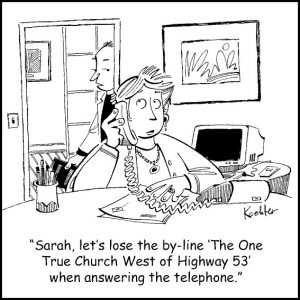
Perhaps the greater danger with denominations is when some feel they are the only true “church” and have a corner market on truth. Frankly, there isn’t a denomination around that hasn’t muddled the message of Jesus in one way or another. New denominations will be no different. New is not bad as long as people realize there is nothing new under the sun. That would make a catchy name for a church, “There’s Nothing New Under the Sun Church.” However, here’s a list of churches you might want to avoid:

  • Don’t Confuse Me with the Facts Church
  • Don’t Call Us We’ll Call You Church
  • I May Be Stupid but I’m Not Dumb Church
  • I May Be Dumb but I’m Not Stupid Church
  • We’re Okay but No One Else Is Church
  • We Know It All Church
  • You Can’t Teach an Old Dog New Tricks Church
  • I Know a Secret and You Don’t Church
  • God Told Me to Do This Church

Consider this… Not much is said about denominations in the Bible but much is said about Jesus – His life, His example, His teachings, His death, and His resurrection. Much is said about love, respect, joy, peace, patience, goodness, faith, meekness, and self- control. These are the qualities to look for. These are the unifying factors you want in a Christian community. Look for these common denominators and the “ecclesia,” the “church,” will be found.

One final thought… It is not a denomination that is saved, but a person.

Posted in Uncategorized | Leave a comment

Choose to Make Church (Meeting Together) a Priority

Choices change our lives…

By Barbara Dahlgren

We do not lack for innovative churches today. In addition to the average denominational listings and their spin-offs, there are cowboy churches, coffee-drinking churches, and drive-in churches – just to name a few. There are small churches, house churches, neighborhood Bible studies, and megachurches. It’s hard to believe one can’t find a place to attend or meet with other believers.

However, some are disillusioned with organized religion altogether. And rightly so! Pharisaical approaches to salvation have muddled the message of preaching Christ. People are no longer enamored with pomp and circumstance. They yearn for the substance of Christ-like teaching.

Others feel they need a time of healing. Maybe they are sick and tired of people or need to do some private Bible study to decide where God is leading them.

The majority just make up limitless excuses like “I don’t like the music,” “the speakers are boring,” “the parking is too difficult to find,” “my spouse doesn’t want to go,” or “the pews are too hard.”

The most popular reason for not attending church is our busy lifestyle. Life is definitely busy! However, it’s not too busy for watching football, shopping at the mall, playing video games, going to the movies, or surfing the internet. Church or meeting together with other believers is just not a priority.

Should attending church or meeting together with other believers be a priority for Christians? After all, don’t we have lots of T.V., radio, or internet options where we can be spiritually fed? It’s true that these ministries offer a service, especially for those who are housebound or perhaps taking a respite to reevaluate where God is leading them. However, if one uses these programs as an alternative to actually spending time with other Christians, they may be isolating themselves and forfeiting what God intended.

Here are some reasons some reasons why meeting together should be a priority:

  • Ecclesiastes 4:9-12 states that “two are better than one.” Life is designed for companionship not isolation. A cord of three ropes together is harder to break than one alone.
  • God has called us to be part of a community of believers so we can learn to work together and get along. We are many members but a part of one body. (Romans 12:4, 5)
  • Sharing thoughts and ideas about scriptures with fellow Christians gives us a different perspective – an iron sharpening iron process which can provide checks and balances on how we conduct our daily lives. (Proverbs 27:17)
  • Private worship is essential for a Christian, but much is gained by community worship as well. There is something quite special about singing and praising God with others who love God as you do. Psalm 95 says, “Come let us worship…” The pronoun is plural.
  • Church is like a large support group. We can be uplifted but we support others as well. Listening skills can be honed and empathy developed. Praying with others, pointing them to God, and letting them know they are not alone – these are all part of the Christian journey.
  • Striving to live a Christian life sends a clear message to those around us. Attending church reinforces that message. It says, “I think meeting with other Christians is important. I try to practice what I preach.” (Philippians 5:9)

Consider this… Going to church each week reminds us of who we are – people struggling to follow Christ.

One final thought… I think there is much truth in this Billy Graham quote: “Churchgoers are like coals in a fire. When they cling together, they keep the flame aglow; when they separate, they die out.”


Posted in Uncategorized | Leave a comment

Choose to Meet Together with Believers

Choices change our lives…

By Barbara Dahlgren

The “church” we have come to know with its traditions, formalities, and idiosyncrasies is not modeled in the Bible. As cities were proselytized in biblical times, Christians would gather together regularly in homes. When groups grew larger, several houses would be designated to become “house churches.” (Romans 16:5, 10, 11; Colossians 4:15; Philemon 1:2) It wasn’t until after Constantine converted to Christianity that official Christian church buildings were constructed.

Just because “house churches” were the norm in those days does not mean this model was set in stone in heaven as the only way to meet to worship God. Some of these house churches met every day. Does that mean it is mandatory that we meet together seven days a week? In theory, this is a great idea; in application, it would be hard to do.

The key is not where they were meeting, but the fact that they were meeting together. This is the constant throughout the New Testament. Like-minded Christians were meeting together often to worship God, to discuss how to serve others, to pool resources, to learn about spiritual growth, to share the love of Christ, to build friendships, and to connect.

Getting together was paramount in the eyes of Christians. All the believers met together. They prayed together. They worshipped together. They ate together. (Acts 2:42-47) The indication seems to be that Christians should be meeting together with other Christians.

A few weeks ago I met a friend I hadn’t seen in over a decade. We chitchatted a bit about family and jobs. Then she said, “I don’t go to church anymore but I like to think of myself as a Christian.” This has become a norm with people. In fact, church attendance has declined so dramatically in the United States that foreign countries now feel they need to send missionaries to us.

“I like to think of myself as a Christian.” That’s an interesting statement. I like to think of myself as intelligent, thin, witty, beautiful, and the winner of a Pulitzer Prize but that doesn’t make it so. Christianity is more than just merely believing in the existence of Christ. Even demons believe in the existence of Christ. (James 2:19) To be considered a Christian, it must take a little more effort. (James 2:18-26)

Look, you can use any argument you want to convince yourself that you can be a Christian but not attend a church or at least a small group Bible study of some kind, but it’s just idle chatter.  Christians need fellowship with other Christians. (1 Corinthians 12:12) Early Christians met together every day which is not really feasible in today’s society, but to say, “I like to think of myself as a Christian” and not be meeting together with believers regularly might lead one to respond with “better think again.” Thinking it does not make it so.

Consider this… Whether or not you view “the Church” as an individual Christian or a group of Christians, one characteristic of a believer appears to be getting together with others. This could be going to church or meeting with others at someone’s home, a warehouse, a school, a restaurant, or a conference room at the Holiday Inn. The operative words are “meeting together!”

The Bible instruction is pretty clear on this subject in Hebrews 10:25. “And let us not neglect our meeting together, as some people do, but encourage one another…”

One final thought… Fellowship is a basic component of the Christian life. It’s hard to fellowship by yourself.


Posted in Uncategorized | Leave a comment

Choose Not to Be an Isolated Christian

Choices change our lives…

By Barbara Dahlgren

Christian loners may be shocked to find out that God is more about community than individualism. He models this in the Trinitarian relationship of the Father, Son, and Holy Spirit. It is further exemplified in the grace-filled gesture of making salvation available for all mankind so we, too, can enter into that relationship.

Whether we like it or not, people are interconnected. We are interconnected with God and with each other. So isolation for the Christian is not a viable option. Christians should be coming in contact with non-Christians so they have someone to share the gospel with, but they should also be meeting regularly with like-minded believers for encouragement and edification. This can be done by going to church, a Bible study, or a small group. In other words, Christians should be meeting regularly with a community of believers.

Jesus Christ ascended to heaven and left His followers on earth to communicate His message of salvation. They did this by worshipping Him, serving Him, serving others, growing in a relationship with Him, and sharing the gospel. So in essence, each individual was “the Church.” However, the analogy might go awry when people use this philosophy as a license for not meeting together with other Christians. For not only were these believers “the Church” independently, they were “the Church” collectively, as well.

Some get turned off at the concept of attending church. They think more harm than good has been done in the name of Christianity. It’s true that some atrocities have been done in the Name of Christ but that doesn’t make it right. There is a lot of good that comes from churches. Christian churches have pushed for every humane reform conceivable which includes providing education for all classes of people, cleaning up hospitals, opening orphanages, feeding the homeless, being the first to integrate in the South, and much more. In fact, there was a time that church was the only thing that could cross the color line and get away with it.

Some use the argument that going to church will not make you a Christian any more than going to a garage makes you a car. That is true. A local church is only as good as the Christians who attend it. But if you want your car fixed, you take it to a garage. If you want to find other Christians, a church might be a good place to start.

From the beginning, God said it wasn’t good for man to be alone. (Genesis 2:18) There are things we gain by being with others that we can’t learn by being isolated. Loners never have to focus on anyone but themselves. That’s not what the Christian life is all about. While it’s true that people can be irritating, Christian concepts like caring and sharing are hard to develop all alone.

Consider this… Churches are filled with imperfect, struggling people. Churches are hospitals for sinners, not sanctuaries for saints. A perfect church would have no members.


One final thought… Instead of looking for perfection in people, why not look for progress? Look at how far they’ve come, not how far they have to go. If you think those people are imperfect now, you should have seen them a year or two ago.


Posted in Uncategorized | Leave a comment

Choose to Explore Contradictory Concepts

Choices change our lives…

By Barbara Dahlgren


There is no denying we live in a world where something good is referred to as bad and something can be so hot it’s considered cool. We have become adept in accepting things that sound illogical. That’s why the oxymoron is so common today.

Oxymora are phrases where words that seem to have opposite meanings are used together for a special effect. It’s a contradiction in terms. One example would be “pretty ugly.” How can something be “pretty” and “ugly” at the same time? Who knows? But in the English language, it is commonly accepted.

The word “oxymoron” is an oxymoron in itself. It comes from the ancient Greek. “Oxus” means sharp or keen; “Moros” means dull or foolish. Therefore, we have a word which means sharp dullness or as some like to say, “a foolish wise.” I guess some things we’ll never understand, but in all its incongruousness, the oxymoron permeates everyday communication.

Here are a few and I’m sure you could come up with many more. The list is endless.

  • same difference
  • living dead
  • virtual reality
  • sweet sorrow
  • limited lifetime warranty
  • original copy
  • authentic reproduction
  • definite maybe
  • local long distance
  • genuine imitation
  • pail volunteers
  • non-dairy creamer
  • new classic
  • honest thief
  • quiet noise

Some oxymora have become so laughable you rarely see them anymore. Who can say honest politician without smirking? Anyone using those words together must be terribly nice or standing fast on bittersweet memories of days gone by and unaware of the constant changes in our society. Good grief! But I digress…

So adept have we become at accepting this way of communicating that I’m amazed people have trouble believing the Bible. For at first glance, it appears to have many contradictory concepts as well. We have the virgin birth which many would consider an oxymoron. We have the long awaited Messiah, Jesus Christ, coming to earth as a baby not a warrior. After He convinces everyone He is the Savior, He is crucified and dies. Then He is resurrected and goes off to heaven. God just doesn’t seem to do things in what we humans would call a logical way.

There are other things God mentions that may seem illogical to us:

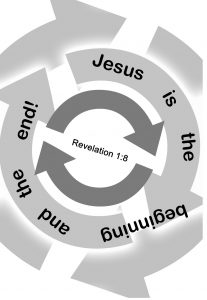
  • Jesus is the beginning and the end. (Revelation 1:8)
  • God became flesh and dwelt among us. (John 1:14)
  • If we want to get, we must give. (Ecclesiastes 11:1; Luke 6:38)
  • We must forgive others even if they don’t forgive us. (Matthew 6:15)
  • If we want to live forever, we must die. (Matthew 16:25)
  • Freedom means serving others. (Galatians 5:13)
  • God uses the foolish to confound the wise. (I Corinthians 1:27)
  • To be exalted, we must humble ourselves. (Matthew 18:14; 1 Peter 5:6)
  • God loved the world so much He sent His Son to die for it. (John 3:16,17)

Consider this… On the surface this list may seem like a contradiction of concepts. However, just like oxymora are used for special effects, God uses Biblical phraseology in the same way. It deepens our understanding of salvation and enhances our relationship with God.

Perhaps if we gave the Bible the same consideration we give our everyday language, these concepts would not seem so foreign to us. In a world where good can be bad but really be good, it should be easier to accept the concept that Jesus lived and died but can really be alive!

One final thought… Just because we can’t see a physical image of God, doesn’t mean He doesn’t exist. And that’s the long and short of it!


Posted in Uncategorized | Leave a comment

Choose to Be Perfect

Choices change our lives…

By Barbara Dahlgren

Reading “Be ye therefore perfect, even as your Father which is in heaven is perfect” in Matthew 5:48 reminds me of all my imperfections – which are many to be sure. The imperfection I hate most in my life is that I’m not perfect.

Those who struggle with perfection know too well the feeling of never really being good enough. We are like those children learning to write the alphabet for the first time who tear their papers up the second they see they have malformed a letter. It makes no difference that they made it to the “R” without a problem. If the “S” looks sloppy, then in the trash it goes. Practically perfect people are hard on themselves.

In psychological terms, perfectionism is the belief that perfection can and should be attained. When that belief transforms into thinking anything less than perfect is unacceptable, problems occur. Through a perfectionist’s eyes, a person’s self-worth is determined by flawlessness. Of course ideas of perfection vary from person to person. Perfectionists set rigid standards of performance for themselves and sometimes for others. They never feel they “measure up.”

One of my favorite movie lines comes from Mary Poppins when she humorously replies, “We practically perfect people never make mistakes.” Poppins, like most everyone else, links perfection to lack of mistakes. Sometimes Christians make the same error in reading the Bible. Actually the word “perfect” in the above scripture is “telios” meaning finished, full grown, mature, lacking nothing, or brought to completeness. It has nothing to do with making mistakes or not being good enough.

People commonly think that all perfection is about physical achievements such as being good, successful, or sinless. When God speaks of perfection, He wants us to “be complete” by being spiritually one with His Son Jesus Christ. This perfection is not designed to make us look good or perform flawlessly, but to let Christ’s life be manifest through us. Physical perfection is more concerned about actions we perform to a certain level, whereas spiritual perfection is about becoming totally dependent on God, letting Him work through us to perform His will – not ours. It is not concerned about “self.”

The good news is that we are already perfect in God’s sight. We are reconciled through Jesus Christ and He lives in us. This perfection does not come from our false concepts of trying to be good enough. On our own, we will never be good enough.

Consider this…It is not about our goodness; it’s about God’s greatness. With Christ in us, we are brought to completion and we lack nothing.

Will we make mistakes? Sure. But remember – the perfection spoken of in this scripture is not about what we do; it’s about what Christ does.

One final thought… Christ’s life in us makes us perfect or complete.


Posted in Uncategorized | Leave a comment

Choose to Do It Anyway

Choices change our lives…

By Barbara Dahlgren

I remember once my daughter told her son to do a certain task. He balked and told her he didn’t want to do it. She didn’t get upset like I probably would have. She just calmly and sweetly replied, “That’s too bad. Life is full of things you will have to do that you don’t want to do, but you will have to do them anyway.” What a wonderful way to weave a life lesson into an everyday occurrence!

Do it anyway! What a concept! The Bible is full of instructions that I would rather not do. I struggle with all those “love one another” scriptures. I struggle with loving my neighbor as myself, loving my enemies, and even sometimes loving those closest to me (Mark 12:31, Matthew 5: 43-44, Ephesians 5:25). However, if I profess to be a Christian, I will have to do it anyway.

It’s hard to love people who are self-centered, unappreciative, and unreasonable. It’s hard to love people who don’t love you back. It’s hard to love someone who is irrational, illogical, or selfish. It’s hard to love those who verbally attack you, put you down, or spread unfounded rumors about you. However, the biblical instruction seems clear – love them anyway. Do it anyway!

An overview of Godly love can be found in 1 Corinthians 13. It is patient, kind, not envious, believes the best, endures, not resentful, and so on. However, it doesn’t say loving people means we should condone and accept everything they do, let them run roughshod over us, or give them everything they want. Love is not gullible. Nonetheless, even though love is a choice more than an emotion, it can still be a difficult and hard choice to make at times.

Nowhere is this more evident than with the sacrifice Jesus Christ made for us. God so loved the world that He gave His Son for us. (John 3:16, 17) Jesus so loved the world that He died for us.  (John 10:18) His motive was love. He had no guarantee we would love Him in return; in fact, many reviled Him for this act of love.

Jesus gave Himself freely for us. Sometimes I think we minimize the thought process Jesus went through before that crucifixion. Even though He knew in advance what was going to happen, there was certain distress or why would He say, “My Father, if it is possible, let this cup pass from me…?” (Luke 22:42) Many debate exactly what this “cup” was. These debates present interesting speculations, but personally I don’t need to know what the “cup” was. For me it’s enough to know it was an agonizing choice. “And being in anguish, he prayed more earnestly and His sweat was like drops of blood falling to the ground.” (Luke 22:44) It wasn’t easy, but He did it anyway.

Consider this…Mankind is unworthy of such sacrifice – such love. Jesus knew what it meant to do it anyway. He did it for me and He did it for you. I’m so glad He did!

One final thought… Since Jesus died for us, perhaps we should live for Him.

Posted in Uncategorized | Leave a comment

Choose to Be God-Centered

Choices change our lives…

By Barbara Dahlgren

I hate to admit it, but my world tends to revolve around ME and all things related to ME – my home, my family, my community, my city, my state, my country, my likes, my wants, my needs, my dreams, my passions, my opinions, and my thoughts. I am the center of my world and God loves ME!

Sometimes I forget that although God loves ME, He loves everyone else, too. I may be the center of my world, but I am not the center of God’s world – and it’s His world that counts. So from time to time I have to do a reality check. My world should not revolve around me; it should revolve around God.

When God becomes the center of my world, my world view or perspective changes. Exclusive concepts focusing on “me, myself, and I” are replaced with inclusive Trinitarian thinking focusing on “we and us.” Neighbors and coworkers are not just acquaintances but brothers and sisters in Christ. A panhandler is not just a beggar but a child of God. A homeless person is not an outcast, but someone God loves. God loves all of us, not just me.

Am I jealous that God loves others as much as me? I shouldn’t be – not when I fully understand God’s capacity for love. God can love all of us and still have a special, intimate relationship with each one as an individual. That’s just how great He is!

When we realize how much God loves us and how great He is, we don’t just want Him to be part of our world; we want Him to be at its core and center. Apart from Him we can do nothing. (John 15:5) In Him we live and move and have our being. (Acts 17:28) We want to stay connected through prayer. (1 Thessalonians 5:17) His thoughts are not our thoughts, so we try to align to His way of thinking. (Isaiah 55:8) This is accomplished by internalizing and writing His words on our heart. (Proverbs 7:1-3) We meditate on scripture and apply it to our lives. (Psalm 119:15)

God knows everything and we don’t, so we want His will to supersede ours. (Luke 22:42) He has only our best interests in mind, so we adjust to what God wants to do, not what we want to do. Our agendas decrease as His become more manifest. We focus on Christ because that’s how we survive.

Remember the example of Peter? As long as he stayed focused on Christ, he walked on water. When his attention shifted off Christ, he began to sink. (Matthew 14:30)

Consider this…As our personal lives become more God-centered, we notice our perspectives slowly changing. We start seeing the world around us through God’s eyes instead of our own. We realize we were created by God and for Him, so we actually start thinking about God more than self. (Colossians 1:16)

I must admit, I still struggle with wanting my world to revolve around ME. However, in my heart I know it’s not about ME; it’s all about God!

Two final thoughts…If it’s all about ME, then where is space for others? Could it be that I am not as important as I think I am?


Posted in Uncategorized | Leave a comment

Choose to Agree to Disagree

Choices change our lives…

By Barbara Dahlgren

Many live under the assumption that everyone they meet should like them. I have no such unrealistic expectations. How could everyone like me? After all, I don’t like everyone I meet. This includes Christians and non-Christians. Of course, as Christians, I think we should make an effort to get along with everyone, including (or should I say especially) each other, even if we don’t see eye to eye on everything. However, there is no need to put ourselves in situations where we come in constant contact with someone we don’t work well with if we have other options.

Such was the case with Paul and Barnabas. Both Paul and Barnabas were dedicated servants of God. After Paul’s conversion, he had a difficult time convincing Christians of his sincerity. And rightly so! Was this not the man who had been a vicious persecutor of Christians? It was Barnabas who persuaded the disciples to give him a chance, and a friendship formed between the two of them. (Acts 9:26-28) They even went on a missionary journey together.

Joining them on this journey was Barnabas’ cousin John Mark. (Colossians 4:10) For some reason, John Mark decided to return home to Jerusalem while Paul and Barnabas completed the mission. (Acts 13:13) John Mark’s decision did not set well with Paul. When another missionary trip was planned and Barnabas suggested taking John Mark again, Paul balked at the thought. So much so that a “sharp contention” developed between the two of them. (Acts 15:36-41) They couldn’t reach an agreement, so they agreed to disagree and split up. Paul took Silas on his journey, while Barnabas went with John Mark.

Now here were two servants of God who couldn’t agree on an issue. This wasn’t a deep theological or doctrinal concern, yet it was a difference of opinion on how to proceed with the work of God. They decided to go their separate ways. We hear nothing about them bad mouthing each other or putting one another down. They merely agreed to disagree.

The Bible says nothing about who was right or who was wrong in this instance. Some commentaries say Paul was too stubborn. Perhaps, but others feel Paul was guided by logic while warm hearted Barnabas was influenced by John Mark being family. Both Paul and Barnabas were praying to the same God for guidance and both reached a different conclusion. The point is that in some situations there isn’t a right or wrong – just a different point of view.

Although we hear nothing about Paul and Barnabas working together again, years later Paul mentions Barnabas fondly in 1 Corinthians 9:6 as a coworker for Christ. It seems Paul and Barnabas maintained a mutual respect for one another, which is difficult to do when you agree to disagree with someone. Paul even had a change of heart about John Mark. In 2 Timothy 4:11 he says, “Get Mark and bring him with you, for he is useful to me for ministering.”

Consider this…Circumstances change and so do people. How many of us find ourselves eventually valuing someone we once had little regard for?

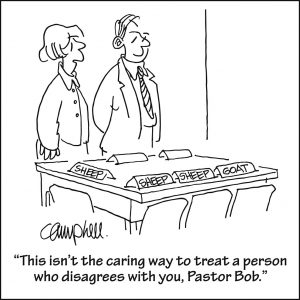
Because we all have different strengths and weaknesses, not everyone we meet is going to like us, nor are we going to like everyone we meet. And no matter how hard we try, we will not get along with everyone. The sooner we realize that, the better off we’ll be. But developing the art of agreeing to disagree can avoid conflict, prevent hasty conclusions, and allow time to reevaluate situations. We don’t have to see eye to eye on every issue to live heart to heart.

One final thought… Believe it or not, there are ways to disagree without being disagreeable.


Posted in Uncategorized | Leave a comment

Choose to Weather the Storm

Choices change our lives…

By Barbara Dahlgren

Years ago traveling preachers would go from town to town, pitch a large tent, preach the gospel nightly for about a week, then move on. People would come from miles around to hear God’s word expounded. In larger cities, such as St. Louis where I grew up in the early 60s, they would set up on a vacant lot near a hub of activity. Whenever I hear Neil Diamond’s song Brother Love’s Traveling Salvation Show, childhood memories of mom hauling us to these revival meetings come to mind.

My dad believed in God but wasn’t what you would call a church-going man in those days, so he only came with us once. Unfortunately, there had been a bad storm the night before, resulting in some tent damage. As we nestled into the back row, the enthusiastic preacher was blaming this mishap on Satan and soon had everyone standing, pointing to the holes in the top of the tent, and shouting, “I hate the devil. I hate the devil.” Everyone except my father that is, who slipped our family out quietly and informed us that a preacher who didn’t have the sense to know God is the One who allowed the rain to fall isn’t one he wanted to listen to.

Dad taught me that while it may be convenient to blame our storms of life on the devil, God is the One ultimately in control. He said, “God is good, but it rains on everyone. Sometimes God stops the rain and sometimes He doesn’t.”

Jesus’ parable about the foolish man and wise man building houses in Luke 6:46-49 illustrates this. The foolish man built his house on a shaky foundation and the wise man built on a solid foundation. Then the rains came. It must have been quite a downpour because the foolish man’s house was washed away. The wise man’s house was not. However, it rained on both the foolish and the wise man. Neither escaped the rain.

Many Christians feel if they are nice to others and follow biblical principles, they will escape the rain. Oh no, my friend. The thunder will roar and the lightning will strike. It will rain on everyone: the good, the bad, the ugly, the beautiful, the just, the unjust, the atheist, and the Christian. No one escapes the rain. It rained on both the foolish and the wise man. However, each had a different result. The foolish man was wiped out, but the wise man was not. The wise man may have had considerable water damage, but he survived because he built his house on a solid foundation.

Spiritually speaking, the house represents our lives and that rock-solid foundation is Jesus Christ. An unshakable foundation can be laid daily by believing Christ, walking with Him, talking with Him, and trusting Him. Those with a shaky foundation cut corners, play the angles, and are self-sufficient. When the storms of life come – and they will come – we rely on whom we have grown accustomed to relying on. Hopefully that will be Christ.

Consider this…We are all children at heart, so when the storms of life come it is natural to be anxious or have concerns. But as the saying goes, “Sometimes God calms the storm; sometimes the storm rages and He calms the child.” Either way, we are far better off trusting God.

One final thought… If you want to see the sunshine, you have to weather the storm.


Posted in Uncategorized | Leave a comment