One More Year of Choices…
By Barbara Dahlgren

The old television show Hee-Haw had a humorous segment with four women called the Gossip Girls singing something like this…
“Now, we’re not ones to go ’round spreadin’ rumors,
Why, really we’re just not the gossipy kind,
No, you’ll never hear one of us repeating gossip,
So you’d better be sure and listen close the first time!”
Pretty funny, huh?
Gossip can have many sides. In fact, some gossip can be good, some bad, and some ugly.

Good Gossip
Is there such a thing as good gossip? Actually gossip has several meanings. One is to exchange light, trivial chitchat. It’s a sort of mutual sharing of information. “Mary used a new hair coloring.” “John got a new car.” “Julie had a baby.” It’s usually common knowledge that one wouldn’t mind sharing with others. This kind of socialization helps us learn to relate to others and can be bonding.
Bad Gossip
However, a second meaning is to spread rumors, usually of a sensitive or intimate nature. Don’t we just love being privy to some juicy, personal tidbit about someone else? It doesn’t even matter if it’s true or not. People may not start out telling half-truths but by the time they tell their closest friends who tell their closest friends who tell their closest friends, the truth can get pretty distorted, but we believe it anyway. As the saying goes, “Some people will believe anything if it’s whispered to them.”
This type of gossip can be harmful and hurtful. Bad gossip is when you have to abruptly stop a conversation because the person being talked about comes into the room. When you are afraid to say it to a person’s face, it can’t be good to repeat.
Ugly Gossip
Ugly gossip deliberately tries to damage a person’s reputation, which goes beyond sharing something you’ve heard. These are lies designed to cause pain and grief. With the Internet, they are all too easy to spread. Unfortunately, when people see something in print, they believe it even more than something whispered in the ear.
This type of gossip can seem quite impersonal, unless you are the target of such maliciousness. School bullies use this technique on kids they don’t like. This cyberbullying results in many young people committing suicide. They even have a term for it called “bullycide.”
No wonder the Bible says, “A troublemaker plants seeds of strife; gossip separates the best of friends. (Proverbs 16:28 – NLT) It also says, “What dainty morsels rumors are—but they sink deep into one’s heart.” (Proverbs 18:8 – NLT)
Consider this… Gossip is like a feather blowing in the wind from place to place. Take ten feathers and release them in a breeze. Then try to retrieve them. It would be an impossible task. Gossip is similar to this. Once we utter gossip, we can’t really get it back because it is blowing around from place to place.
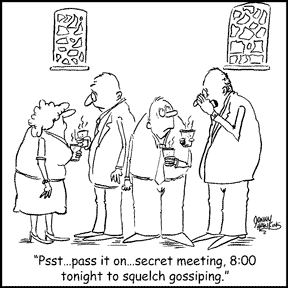
Suggestions for practicing this choice…
- If you have a problem with someone, sort it out between the two of you. Don’t tell everyone else about it.
- Be objective when someone shares discontent with you. Remember, you are only getting one person’s side of the story.
- When someone starts gossiping to you, change the subject. If a simple deflection won’t work then say, “This conversation is getting really negative. Why don’t we talk about something else?” Or say, “I really don’t feel comfortable talking about people behind their backs.”
- Don’t say anything about people to others that you would not say in front of them.
- Think about this acronym when you speak of others.
True – Is it true?
Helpful – Is it helpful?
Inspiring – Is it inspiring?
Necessary – Is it necessary?
Kind – Is it kind?
Since someone shared this with me and I’m sharing it with you, let’s just say this is some good gossip you can share with anyone who tries to share bad gossip with you – to keep rumors from getting ugly.
 I recently read an article about a woman who wanted her husband to put his dirty clothes in the laundry hamper instead of dropping them on the floor. The author went to great length explaining that there was probably some sort of underlying, psychological reason why the man didn’t want to put the dirty clothes in the hamper. I’m not singling out men here. Some women have the same problem. The author felt that if they could get to the core of the reason behind the action, the problem would be solved.
 We live in a society where people do not want to accept responsibility for their actions. If people spill hot coffee on themselves, it’s the restaurant’s fault for making the coffee too hot. If a person shoots someone, it’s the gun manufacturer’s fault. If a person drives drunk, it’s the bartender’s fault. If a child misbehaves, it’s the music industry’s fault. If a smoker dies from lung cancer, it’s the tobacco industry’s fault. Should gun manufacturers, restaurants, bartenders, the music industry, cigarette makers, and others act more responsibly? Yes! Are they to blame for the choices we make? No!

 Each New Year we make resolutions to help us change our lives for the better. Although we usually have every intention of keeping them, all too soon they are abandoned because change is hard. Most of us want changes to instantly happen without any effort on our part. We think if we write them down they will miraculously come to pass. Unfortunately, that’s not how it works.
 People keep or observe Christmas for a few reasons. For adults, it’s a time for families to get together. For parents, it’s a time to give gifts to their children. For children, it’s time to get presents. For Christians, it’s all of these plus a time to celebrate the birth of Christ.

 Most of us are in the midst of Christmas shopping. Choosing the right gift for someone can be a challenge. Those of us who don’t have money to buy expensive gifts to lavish on loved ones or even put a dollar or two in Santa’s Salvation Army bucket may feel a little down. But do not despair! There are gifts you can give that cost little or nothing, yet are very valuable.




 Our brains were designed to be social. Studies show the gray matter between our ears is actually busy every moment, picking up messages and responding. Two-time Pulitzer nominee Daniel Goreman reinforces this in his book Social Intelligence. Goreman says, “The brain itself is social.” Not only that, but mirror neurons actually cause people to respond to what they see or feel. This is why smiles, frowns, and yawns are contagious.